
Kazakh Tea, 2017. Oil on canvas. From the artist’s personal archive
Akzhana Abdalieva
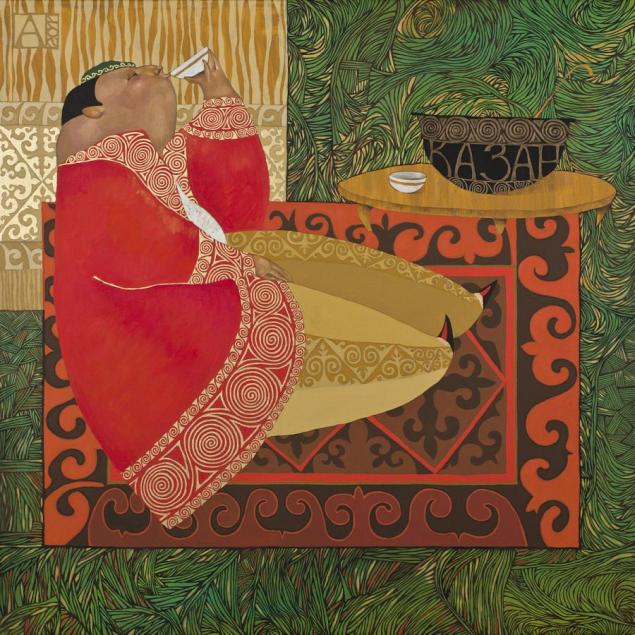
At the centre of the composition is a man immersed in a state of absolute calm and inner contentment. He is drinking tea from a bowl, his head tilted back slightly, as if completely lost in the moment of enjoyment. His figure occupies a significant part of the pictorial space, giving the scene of an everyday tea-drinking session a symbolic meaning. The artist emphasises the importance not of the action itself, but of the state of tranquillity.The composition of the work is constructed in a decorative and stylised manner. The figure sits on an ornate tekemet, whilst the surroundings are filled with thick, stylised grass rendered in expressive green brushstrokes. The background functions as an ornamental plane into which the figure is organically integrated.Ornamentation becomes one of the key artistic features of the work. Patterns are present in virtually every element of the painting: in the protagonist’s clothing, the texture of the carpet, and the decorative interior design. Here, ornamentation serves as a distinctive cultural code. The work becomes a kind of ode to the ability to savour the moment, to feel the fullness of life through familiar everyday rituals.