Traditional and contemporary art of Kazakhstan

A Virtual Journey into the World of Kazakhstan’s Artistic Heritage

This Web Gallery presents the diversity of artistic practices in Kazakhstan, reflecting the continuity of cultural traditions and the dynamic development of contemporary creative processes. The virtual exhibition features works based on national images, symbols, and themes, as well as artworks by contemporary artists who reinterpret the country’s cultural heritage through contemporary artistic forms, expressive means, and modern technologies.

The selected works demonstrate the relationship between traditional and contemporary art, revealing the distinctive features of the national worldview, cultural identity, and cultural meanings. The presented materials allow viewers to trace how elements of historical and cultural heritage are reflected in contemporary artistic practice, while maintaining their significance and relevance in an increasingly globalized world.

The Web Gallery is aimed at promoting Kazakhstan’s artistic heritage, expanding public access to works of art, and fostering a lasting interest in national culture and art among a wide audience.

Jug. Kuyruktobe settlement

From the book: The Artistic Culture of Central Asia and Azerbaijan, 9th–15th Centuries. Volume II. Glass. — Samarkand-Tashkent: MICAI, 2011.
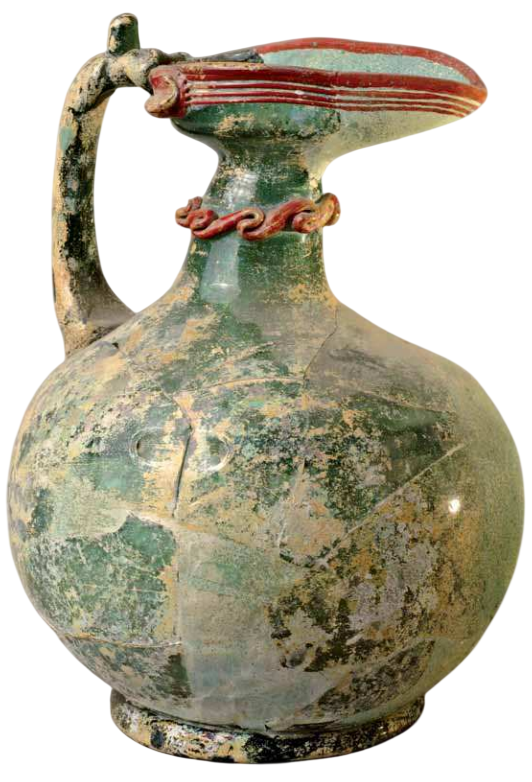
In terms of shape, the vessel belongs to the type of jugs similar to a kumgan, as evidenced by its rounded body, elongated neck, spout and handle. Such vessels were used for storing and pouring liquids.The composition is characterised by harmonious balance: the spherical body ensures stability and capacity, the tall neck, widening towards the top, lends the silhouette a pronounced vertical dynamism, and the substantial handle is sculpturally integrated with the body, forming a unified and complete outline.The asymmetry of the silhouette, caused by the elongated spout, lends it particular expressiveness; this defines the direction of the form and enhances the sense of movement.The vessel is decorated using the technique of applied glass ornamentation: coloured glass threads of a reddish hue run along the rim; in the neck area, a twisted cord forms a relief band, whilst the body is decorated in a restrained manner, without excessive ornamentation.