
Syr Carpet, early 20th century
1st half of the 20th century. 160×335 cm. KP 879, Central State Museum of the Republic of Kazakhstan (Alimbay 61)
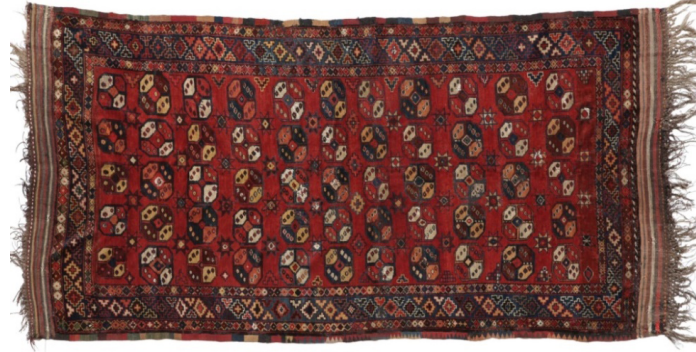
The pile carpet, commonly known as ‘syr kilem’ or ‘qonyrat kilem’, embodies a local variation of the wider regional artistic traditions of the Syr Darya. The craftswomen of the Qonyrat tribe, having mastered the regional tradition with great skill, were able to make the carpet a marker of identity, preserving it in the folk memory under their own name.Compositionally, the carpet is entirely covered with four- and eight-pointed rosettes and an eight-toothed pattern, whilst the entire perimeter is decorated with the ‘alaqurt’ ornament. Such a composition with a border belongs to the ‘closed’ types, interpreted as the embodiment of a protected world model, with the border serving as a kind of ‘guardian’ (Kokumbaeva 116). In turn, the mesh-like design of the entire field of the carpet with ornamental elements (mesh composition), ‘according to traditional beliefs, reflects the idea of unity and interconnectedness of the various clans of a single tribe’ (Kokumbaeva 116).