
Arabic carpet, 20 th c.
Collection of the A. Kasteev State Museum of the Republic of Kazakhstan.
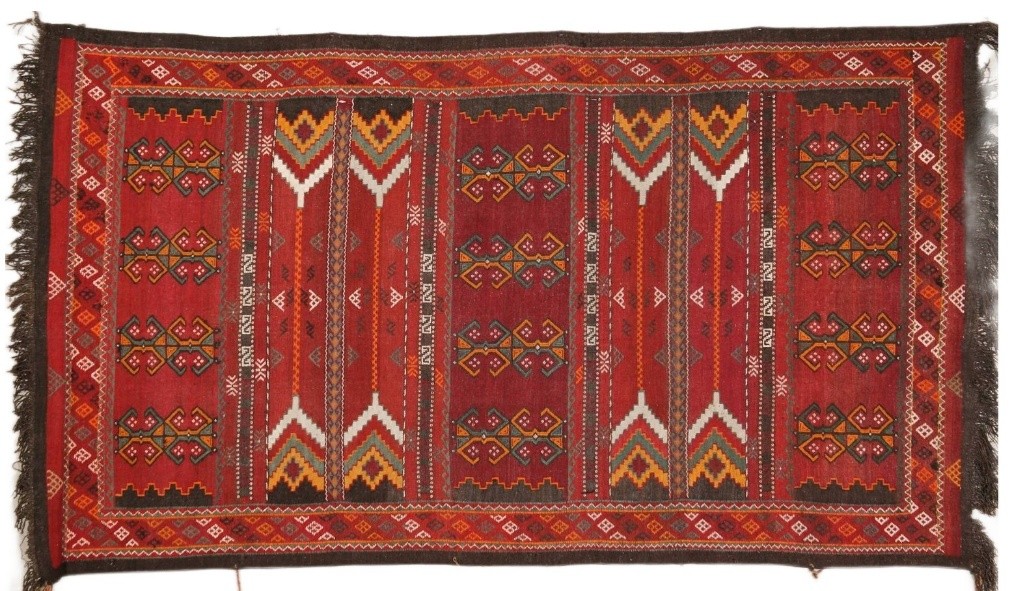
‘Araby kilem’ were woven across a vast area of Kazakhstan. The name itself indicates their origin and testifies to the borrowing of the tradition from Arab settlers in Central Asia.Researchers associate this type of carpet with the Arab wedding carpets known as jihaz (from the Arabic jihaz, meaning ‘dowry’), which formed part of the dowry and symbolised the future family’s prosperity. It is likely that the migrants brought to the region not only weaving techniques but also the symbolism of the ornamentation, associated with notions of family happiness, prosperity and the protection of the family hearth. N. Bazhenova writes of this type of carpet: the ‘araby kilem’ is characterised by a well-established ornamental composition in the central field – a vertical alternation of bands of varying widths. Two principal motifs stand out in the carpet’s structure: the alabas (‘variegated peak’) and the ormekshi (‘spider’). The first motif consists of a vertical shaft, the base and top of which mirror each other. The ornament is formed from multi-layered, stepped triangular shapes of varying colours. Experts interpret it as the World Tree – Omir Agash, whilst the örmekshi pattern is seen as the most ancient archetype of the demiurge – the weaver who weaves the Universe. It is not customary to lay items featuring the örmekshi motif on the floor (Bazhenova).