Traditional and contemporary art of Kazakhstan

A Virtual Journey into the World of Kazakhstan’s Artistic Heritage

This Web Gallery presents the diversity of artistic practices in Kazakhstan, reflecting the continuity of cultural traditions and the dynamic development of contemporary creative processes. The virtual exhibition features works based on national images, symbols, and themes, as well as artworks by contemporary artists who reinterpret the country’s cultural heritage through contemporary artistic forms, expressive means, and modern technologies.

The selected works demonstrate the relationship between traditional and contemporary art, revealing the distinctive features of the national worldview, cultural identity, and cultural meanings. The presented materials allow viewers to trace how elements of historical and cultural heritage are reflected in contemporary artistic practice, while maintaining their significance and relevance in an increasingly globalized world.

The Web Gallery is aimed at promoting Kazakhstan’s artistic heritage, expanding public access to works of art, and fostering a lasting interest in national culture and art among a wide audience.

Fur cap (Borik) 19th c.

Collection of the Aktobe Museum of History and Local Lore. Unknown Artist. Added to the museum’s collection in 1949. 19th century.
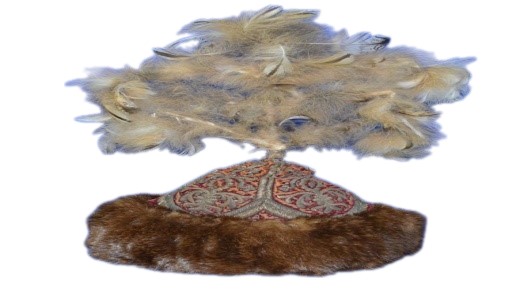
The headdress is round in shape and belongs to the type of girls’ caps. The base of the item is made of textile fabric, richly decorated with ornamental embroidery executed using the twisting technique. The ornament forms a symmetrical composition of plant scrolls and stylised floral motifs.The lower part of the bonnet is trimmed with muskrat fur, which forms a wide, fluffy edge. The upper part of the headdress is adorned with a lush tuft of eagle owl feathers. Such an element served as an important decorative accent and simultaneously held symbolic significance: in traditional Kazakh culture, the feathers of birds of prey were associated with strength, protection and prosperity.The colour scheme of the embroidery is based on a combination of red, light and dark shades, which contrast with the natural colour of the fur. The ornamental composition is characterised by rhythm and balance.