Traditional and contemporary art of Kazakhstan

A Virtual Journey into the World of Kazakhstan’s Artistic Heritage

This Web Gallery presents the diversity of artistic practices in Kazakhstan, reflecting the continuity of cultural traditions and the dynamic development of contemporary creative processes. The virtual exhibition features works based on national images, symbols, and themes, as well as artworks by contemporary artists who reinterpret the country’s cultural heritage through contemporary artistic forms, expressive means, and modern technologies.

The selected works demonstrate the relationship between traditional and contemporary art, revealing the distinctive features of the national worldview, cultural identity, and cultural meanings. The presented materials allow viewers to trace how elements of historical and cultural heritage are reflected in contemporary artistic practice, while maintaining their significance and relevance in an increasingly globalized world.

The Web Gallery is aimed at promoting Kazakhstan’s artistic heritage, expanding public access to works of art, and fostering a lasting interest in national culture and art among a wide audience.

Tagara. 16th–17th centuries. Otrar oasis

Ceramics. 16th–17th centuries. Otrar Oasis. • Photo by Zh.N. Shaygozova
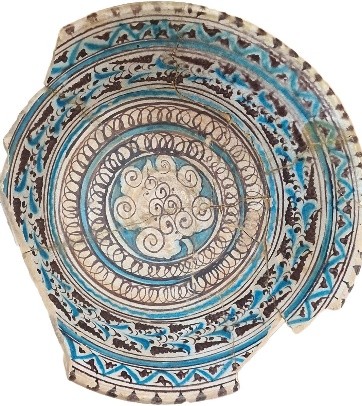
The composition of the dish is based on a strict radial-centrical principle, where the decoration is arranged in the form of concentric bands converging towards a central medallion. In the centre is a stylised spiral rosette, reminiscent of a vortex ornament or cloud motifs, which in folk cosmogony is often associated with celestial energy and the cycle of life. The bands of decorative painting display a rich variety of motifs: both strict geometric zigzags (‘irek’) and elegant loop-like and plant patterns are present here.The colour scheme of the dish is typical of ceramics from the Otrar region of this period: a dominant combination of cobalt blue and manganese- -brown on a light engobe background beneath a transparent glaze. Turquoise and blue hues in ceramics traditionally symbolised water and the sky — vital elements.