
Zharğaq shalbar
From the REM collection
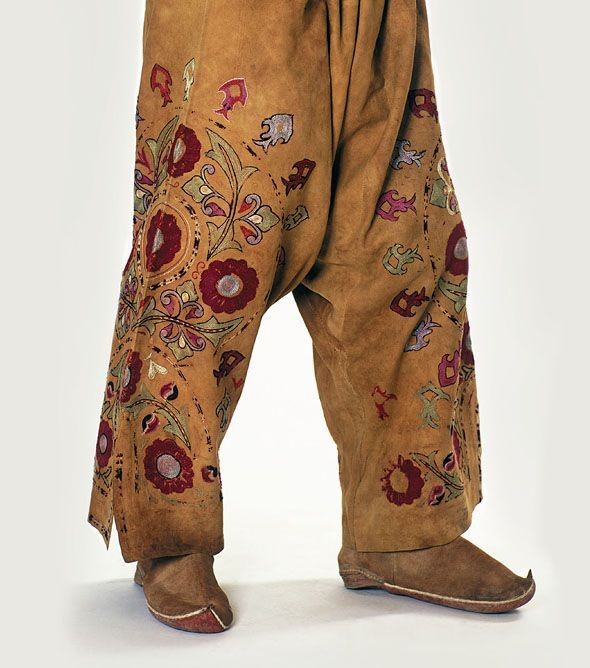
Zhargak shalbarEmbroidered men’s trousers (Kazakh “shalbar”), widely used in Central Asia and Kazakhstan, are a detail of the costume and distinctive markers of belonging to ancient male unions of hunters, warriors, participants in sports competitions and servants. The genesis of this costume detail dates back to the clothing worn by participants in the Iranian ritual wrestling known as khondy. As is well known, the meaning of wrestling, or any combat in traditional culture, can be broadly traced back to the struggle between two forces: dark and light.The Central Asian trousers under analysis were sewn from the finest suede, traditionally yellowish-ochre in colour, originally produced by nomads.Several examples of suede trousers belonging to the Kazakhs are kept in the REM (No. 8762-23497/1), the State Museum of the East and some Kazakhstani collections. These sharovary were decorated with rosette-shaped ornaments on the sides and the sacred bottom was specially decorated. Their decor consisted of embroidery with floral patterns made with silk threads: red, green, blue and partly white.