
Boytumar
Kyzylorda Region. Silver, gilding, engraving, stamping, repoussé, granulation. A. Kasteyev National Museum of Arts of the Republic of Kazakhstan
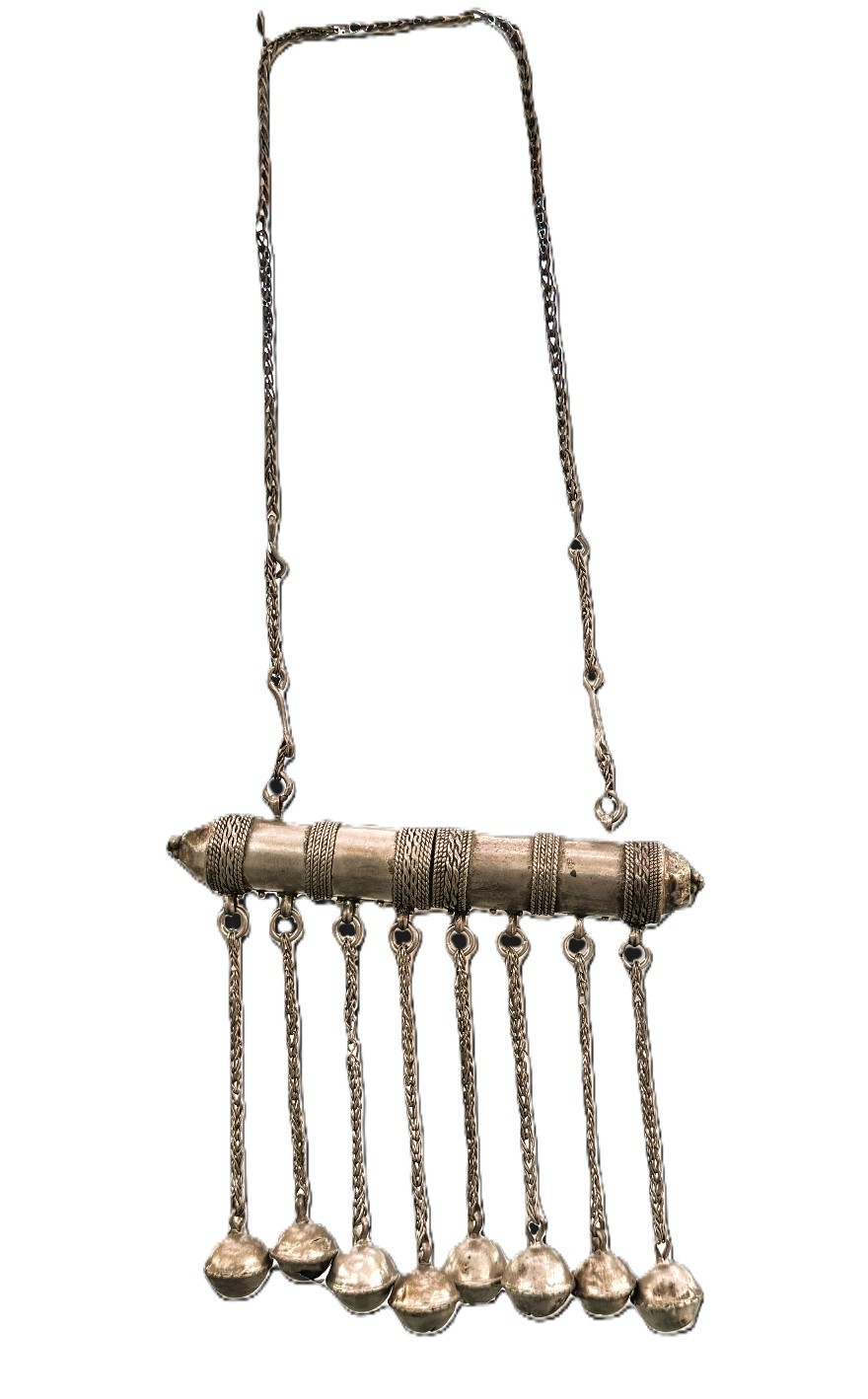
Boytumar (tumar), a pendant amulet. The item belongs to the category of neck and chest amulets, which served a protective and symbolic function in traditional culture.The design comprises a hollow cylindrical body intended to hold the amulet’s contents (texts, herbs, sacred objects). The body is suspended on a chain with side fastenings. The lower part is complemented by a system of pendants: chain elements are attached to the base of the cylinder, ending in hemispherical pendants.The composition is structured along a horizontal-axial principle with a clear emphasis on the central volume. The cylindrical body serves as the compositional core, from which a rhythmically organised system of pendants extends downwards. The vertical chains form a uniform rhythm, enhancing the visual length and fluidity of the piece.The ornamental system is based on a combination of linear and beaded bands encircling the amulet’s body. The decoration emphasises the articulation of the form and enhances its plastic expressiveness. The use of scallops and beads creates a textural richness on the surface and a shimmering effect.The suspended elements serve not only a decorative but also an acoustic function, creating a sound effect when in motion. Overall, the piece demonstrates the combination of utility and sacredness characteristic of traditional jewellery art, where the form of the amulet combines a storage function with protective symbolism.