
Bes bilezik
West Kazakhstan. Silver, stamped, filigree, granulation. A. Kasteyev National Museum of Arts of the Republic of Kazakhstan
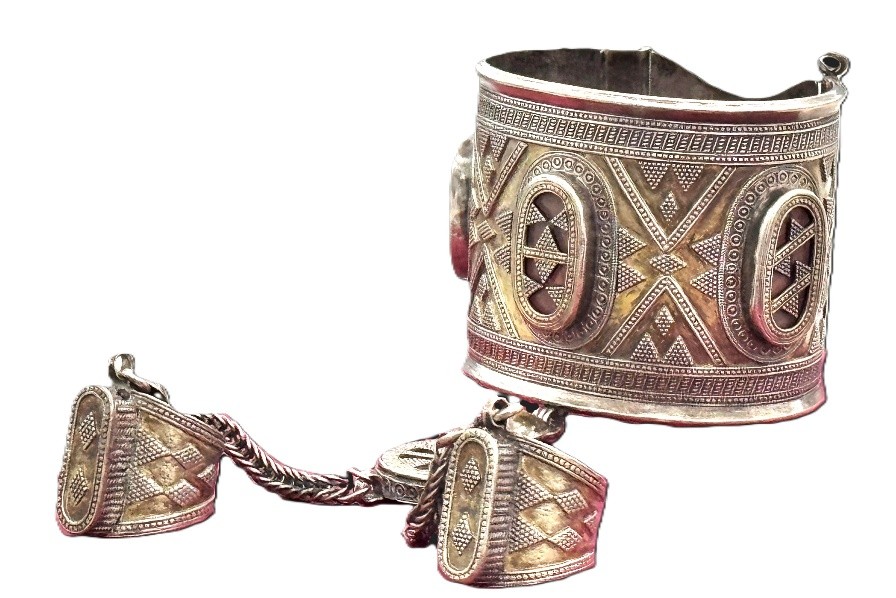
Bes Bilezik — a complex type of wrist ornament characteristic of traditional Kazakh jewellery art of the late 19th – early 20th centuries. The piece belongs to ceremonial forms of jewellery and was likely part of a wedding or status costume.The material is silver; the technique involves stamping, chasing, and elements of scani and graining. The metal surface is treated with relief decoration, creating a rich, textured structure.The design of the piece consists of a wide, open cuff-style bracelet base. Attached to the lower part is a system of suspended elements connected by a twisted chain, which enhances the decorative movement of the form. This combination of a rigid base and moving parts is a characteristic feature of jewellery of this type.The composition is constructed on a frieze principle: the surface of the bracelet is organised into horizontal ornamental bands. The central field is filled with a geometric ornament dominated by X-shaped and diamond-shaped motifs enclosed in oval medallions. The ornamentation is characterised by symmetry and the rhythmic repetition of elements.The decorative scheme combines geometric and stylised zoomorphic motifs, drawing on the traditions of steppe ornamentation. The contrast between smooth and relief sections enhances the piece’s plastic expressiveness. The pendant elements serve not only a decorative but also an acoustic function, creating a subtle sound effect when in motion, which enhances the visual perception of the jewellery in the context of the costume.