
Kus muryn yuzik
West Kazakhstan. Silver, engraving, scan, granulation. A. Kasteyev National Museum of Arts of the Republic of Kazakhstan
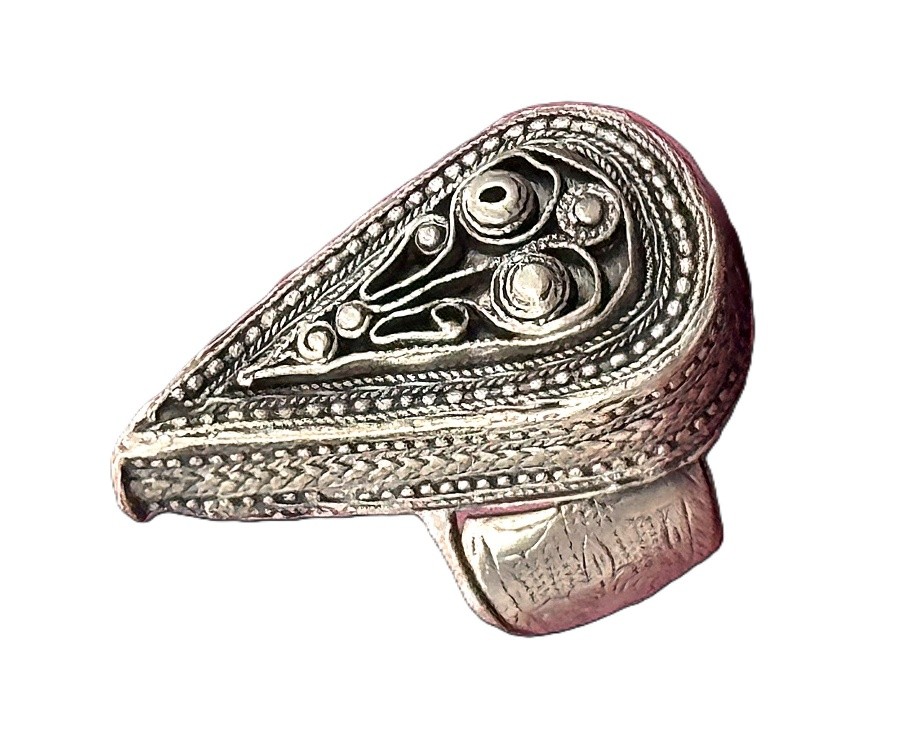
Ring (juzik), ‘qus muryn’ type (bird-beak-shaped shield) A ring with a developed, elongated shield; it belongs to the category of traditional women’s jewellery of a status-symbol and amulet nature.Silver; hammering, engraving, filigree, granulation. A combined technique was used: relief shaping of the shield followed by the application of filigree decoration.The shank is solid and unbroken, flowing smoothly into a widened shield of a teardrop-shaped, elongated (‘beak-shaped’) form. The shield is raised above the base and features a rim with granulation and a wire border. The central part is slightly recessed, forming a compositional field. The composition is axial, extending along the longitudinal line of the shield. The centre is shifted towards the upper part, where the main decorative elements are concentrated. The framing reinforces the directionality of the form and emphasises the dynamism of the ‘beak’.The decoration is executed in the scani technique incorporating granulation: spiral scrolls, teardrop-shaped elements and pseudo-granulated accents. The ornamentation draws on a zoomorphic interpretation (a stylised ‘beak’ of a bird), which in tradition is associated with protective symbolism and notions of defence and vital energy.