
Women’s belt
South Kazakhstan. Velvet, metal, stamping, enamel. A. Kasteyev National Museum of Arts of the Republic of Kazakhstan
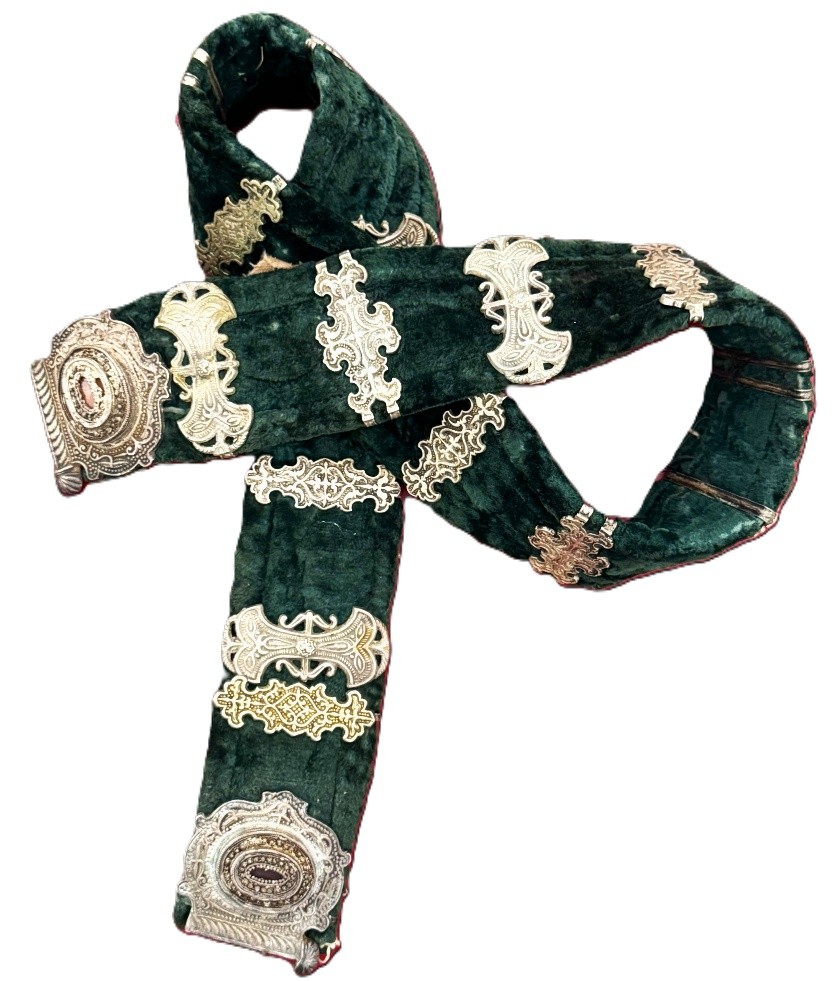
Aiyel beldigi (women’s belt) with metal plates. This item belongs to the category of decorative and status-symbol belt ornaments, which served to fasten clothing whilst also being an important element of women’s attire.The design consists of a textile base (velvet ribbon) onto which metal plates of various shapes are sequentially attached. The belt has an elongated ribbon shape, designed to encircle the waist and hold it in place. The central sections are reinforced with larger decorative elements that serve as compositional accents.The composition is structured according to a linear-axial principle, with decorative elements evenly distributed along the longitudinal axis. Rhythm is created by the alternation of plates of varying configurations—from elongated to curved—with the central elements featuring a more complex shape and larger scale.The ornamental system is based on a combination of geometric and stylised plant motifs. The surfaces of the overlays are decorated with stamped and engraved patterns incorporating symmetrical scrolls and linear elements. Individual details are complemented by enamel inlays, creating colour accents against the metallic surface.Overall, the belt demonstrates a combination of a textile base with metal decoration characteristic of the South Kazakhstan tradition, where the ornamentation and construction form a unified artistic image that emphasises the status and aesthetic significance of the artefact.