
Tarak
South Kazakhstan. Silver, wood, turquoise, engraving, carving. A. Kasteev National Museum of Arts of the Republic of Kazakhstan
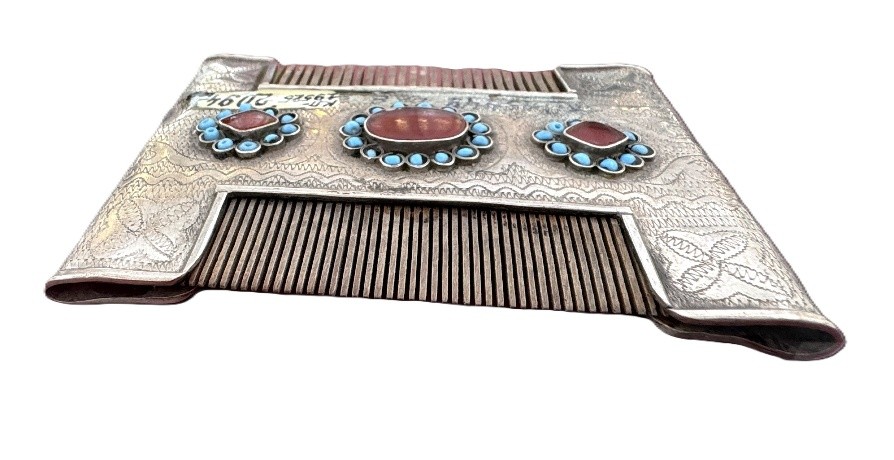
Taraq (comb). The item is a combined comb with a functional and decorative upper overlay. The design consists of a toothed section made of organic material (wood) and a metal silver cladding forming the upper decorative body.The composition is arranged along a horizontal axis with clear symmetry. The central area is highlighted by a large oval inlay (likely carnelian or glass), framed by small turquoise inlays forming a rosette-like motif. On either side are two smaller decorative elements of a similar structure, creating a rhythmic triad.The ornamental decoration of the silver surface is executed using the engraving technique: the background is covered with a linear-wave and floral pattern, incorporating motifs of scrolls and stylised leaves. The ornamentation is organised into horizontal registers, emphasising the length of the form and the structural integrity of the piece.The serrated part of the comb displays a dense, regular rhythm, enhancing the visual dynamism of the lower edge. The contrast between the dark texture of the organic material and the light metal overlay enhances the decorative effect.Technologically, the piece combines several techniques: wood carving to form the teeth, stamping and embossing of the metal plate, and the setting of stones in their sockets.The comb belongs to the category of everyday objects with a pronounced aesthetic function and reflects the tradition of synthesising utilitarian and decorative elements, characteristic of 20th-century jewellery art in Southern Kazakhstan.