
Sary-Arka, 2018. Tapestry, weaving
Saule Bapanova
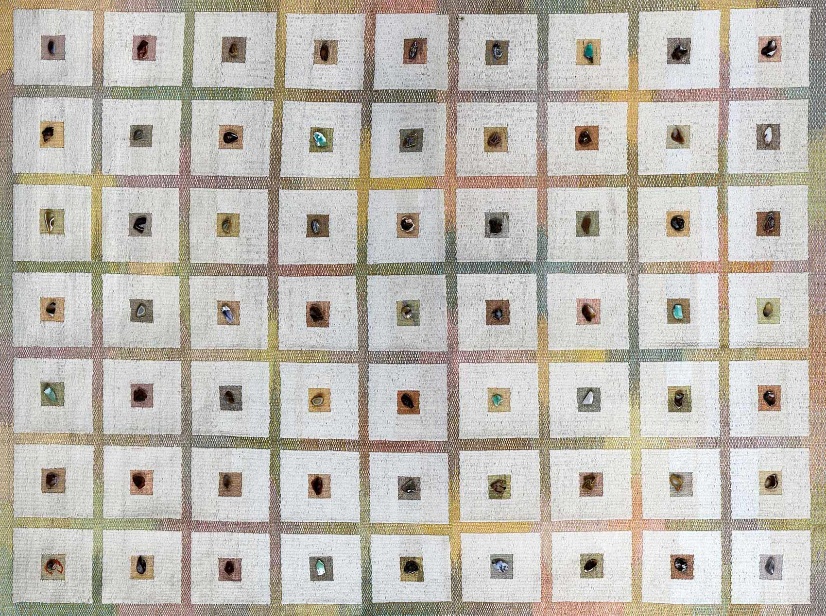
The work ‘Sary-Arka’ is an example of contemporary Kazakhstani textile art in a conceptual format. The artist uses weaving as a means of philosophically exploring space, memory and the cultural landscape.The textural composition of the work is based on a combination of a soft fabric surface and foreign natural elements — minerals embedded within the structure of the canvas. As a result, the tapestry loses its two-dimensionality and takes on a three-dimensional character. The contrast between the flexibility of the textile and the hardness of the stone forms an important semiotic opposition: culture and nature, the man-made and the natural, the transient and the eternal.The composition is based on a strict modular grid that divides the space into equal cells. This structure creates a sense of rhythmic order and is reminiscent of an archaeological catalogue or a system for storing artefacts. Each cell functions as an independent sign, within which a unique stone—a fragment of the steppe landscape—is placed. From a semiotic perspective, the grid acts as a cultural coding system, organising natural matter and transforming it into a vessel of memory.The colour scheme is based on ochre, sandy and muted green shades, evoking the landscape of Sary Arka. Colour serves a symbolic function here: it shapes the image of the steppe as an archetypal space of Kazakh culture. The stones woven into the fabric become a metaphor for the ‘body of the earth’, symbolising antiquity, stability and a connection to the historical memory of the people.