Traditional and contemporary art of Kazakhstan

A Virtual Journey into the World of Kazakhstan’s Artistic Heritage

This Web Gallery presents the diversity of artistic practices in Kazakhstan, reflecting the continuity of cultural traditions and the dynamic development of contemporary creative processes. The virtual exhibition features works based on national images, symbols, and themes, as well as artworks by contemporary artists who reinterpret the country’s cultural heritage through contemporary artistic forms, expressive means, and modern technologies.

The selected works demonstrate the relationship between traditional and contemporary art, revealing the distinctive features of the national worldview, cultural identity, and cultural meanings. The presented materials allow viewers to trace how elements of historical and cultural heritage are reflected in contemporary artistic practice, while maintaining their significance and relevance in an increasingly globalized world.

The Web Gallery is aimed at promoting Kazakhstan’s artistic heritage, expanding public access to works of art, and fostering a lasting interest in national culture and art among a wide audience.

Sufi Kalpak, 2008. Source: Kazakh Art, Vol. 5. Almaty, 2013

Ahmet Akhat
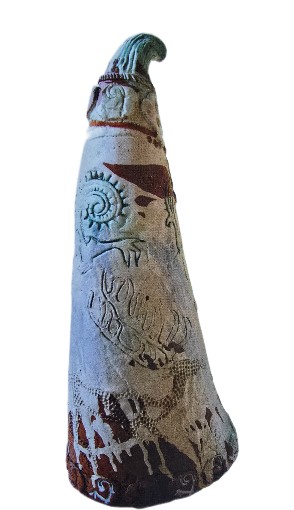
The central element of the composition is a tall, conical headdress – the kalpak – which in this work is interpreted as an independent, monumental image. Its elongated silhouette is associated with the shape of a mountain, a burial mound or a sacred hill. Thanks to this interpretation, the kalpak becomes a kind of ‘axis of memory’, linking earthly space, history and spiritual tradition.The surface of the work is rich with a complex decorative system. Spiral-like ornaments and rhythmic lines are reminiscent of solar symbols, ancient petroglyphs and symbolic motifs from Turkic art. These elements create a distinctive visual rhythm. Here, the ornament acts as a carrier of a cultural code, referring to archaic notions of the cyclical nature of time, humanity’s connection with the cosmos, and the sacred power of the sign.The texture of the surface takes on particular significance. The combination of rough patches, glaze drips and multi-layered colour transitions creates the impression of an object that has endured the prolonged effects of time and the forces of nature.