
Shashbau with an amulet pendant (claw of a bird of prey), silver, carnelian, inlays (stone/glass), organic material (bird claw); casting, engraving, filigree, granulation, pendant assembly. Photo: A. Ibragimov, the artist’s studio
Berik Alibay
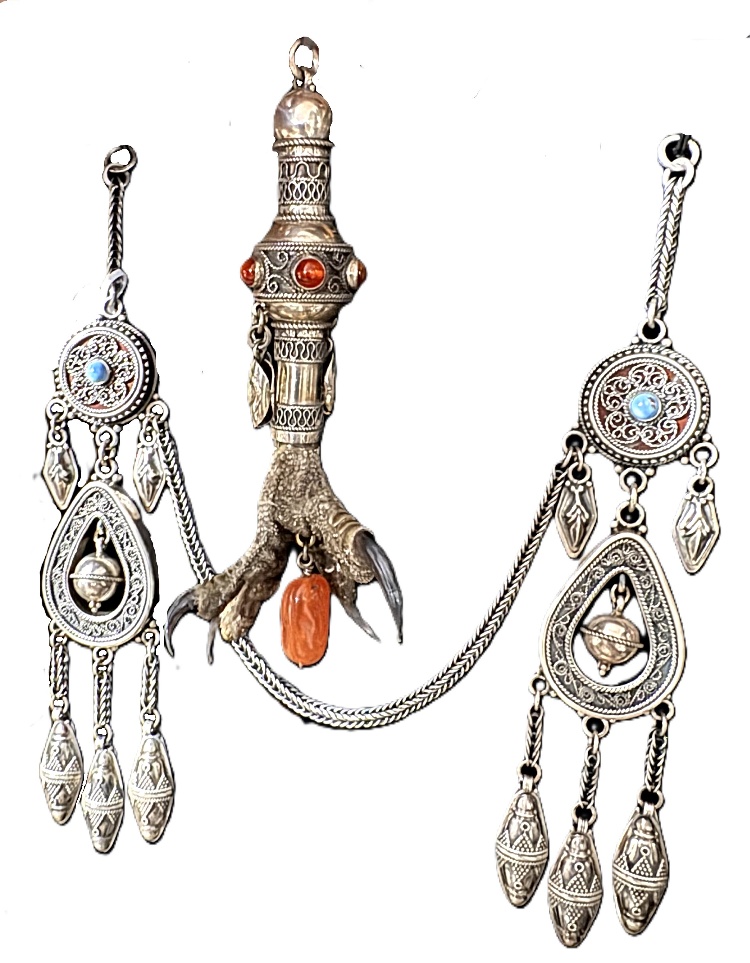
The piece belongs to the category of headdress ornaments — shashbau — complemented by a central amulet element. The design comprises paired pendant modules connected by chains and a vertical central element culminating in a bird of prey’s claw. The composition is designed to be worn in the hair and nape area, creating an elongated symmetrical structure.The design is based on a combination of linear and centric composition. The side sections feature round and teardrop-shaped medallions with ornamental detailing and stone inlays, from which chains with pendants descend. The central module is distinguished by a more complex form: the upper part is designed as a cylindrical volume with carnelian inlays, whilst the lower part is finished with a natural claw set in a metal frame. Despite the overall symmetry of the composition, it is the central element that becomes the main visual focal point.The piece combines decorative and protective functions. In traditional culture, the shashbau not only adorned the hairstyle but also created a characteristic rhythmic sound when in motion. The claw of a bird of prey is associated with notions of protection, strength and the transfer of the animal’s qualities to its owner. Carnelian, in this context, also takes on symbolic significance, being associated with vital energy and resilience.The piece demonstrates a synthesis of traditional form and archaic amulet practices characteristic of contemporary Kazakhstani jewellery art. The artist preserves the typological features of the shashbau, whilst enhancing the piece’s expressiveness through the incorporation of a natural element. As a result, the jewellery is perceived not only as a decorative object, but also as a bearer of cultural memory and symbolic meanings.