
Art object, 21st century. Wood, bone (horn), carving, engraving
Bolat Atamkulov.
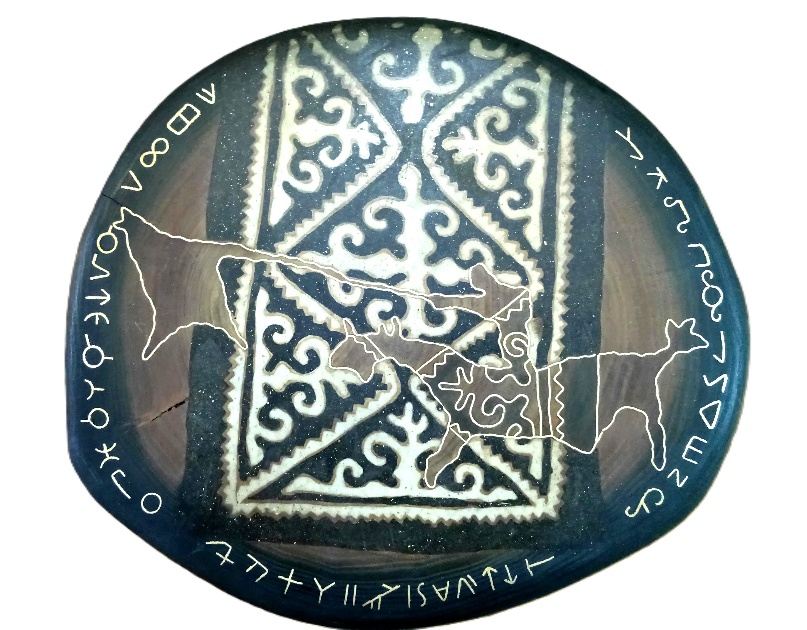
The circular structure of this art object gives the composition the character of a distinctive symbolic field, where ornamentation, graphics and natural material are united into a single visual-semantic system. The work is executed in mixed media using wood and bone (horn), complemented by engraving and linear drawing.The compositional centre is organised around a geometrically precise ornamental core, built on the contrast between light and dark elements. The symmetrical structure of the pattern draws on the traditional Kazakh decorative tradition, yet its interpretation is extremely concise and stylistically aligned with contemporary graphic design. As a result, the ornament is perceived not as an ethnographic reference, but as a universal system of visual signs.A figurative animal motif, applied over the ornamental field using the technique of line engraving, lends the work particular expressiveness. Its stylised interpretation creates the effect of two artistic systems—decorative and graphic—overlapping. This interaction disrupts the static nature of the symmetrical composition and introduces an additional level of interpretation linked to archaic notions of the totemic image and symbolic imagery.The outer contour of the object is organised as a closed rhythmic band, incorporating stylised symbols and grapheme-like elements. These create a sense of a coded structure and reinforce the associative link with ancient writing systems, petroglyphs and sacred ornamentation. The circular shape of the object further emphasises the idea of cyclicality and the completeness of the space.The material contrast between the smoothly finished surface and the natural texture of the bone element plays a significant role. Wood serves as the structural and compositional foundation, whilst bone enhances the work’s plastic and symbolic richness. The interplay of materials emphasises the transition from a natural form to an artistically organised sign.