
‘The Classics’ Farewell to the People’, 1997
Elena and Viktor Vorobyov • Performance
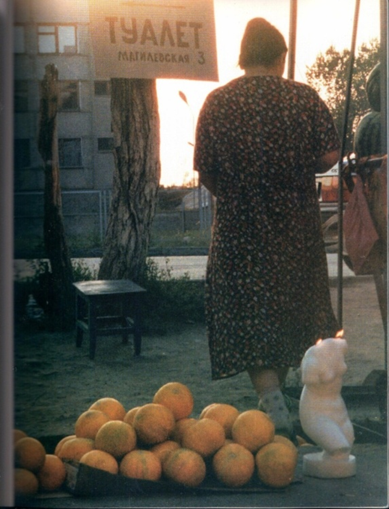
Elena and Viktor Vorobyov’s project ‘The Classics’ Farewell to the People’ was staged in 1997 in Almaty during the early days of contemporary art’s development, and was repeated in 1999 in Istanbul at the 6th Istanbul Biennial of Contemporary Art. The 1990s were a time of upheaval for the country, not only marking the collapse of the familiar social order, but also representing a historic turning point in the perception of classical harmony as the sole rational approach in art (from the Latin *classicus* – exemplary). One of the key signs of the changing life of the metropolis was the proliferation of spontaneous, unorganised markets. The artists’ creative concept lay in the practice of ‘sending a message’ to the people: they installed in the market scaled-down, wax-cast replicas of ancient sculptures (such as the Venus de Milo) in the form of candles, which, when lit at dusk, flickered with a gentle flame in the gathering darkness and slowly burned out, melting away before the eyes of a diverse crowd. Metaphorically and conceptually, this artistic performance conveyed a specific message – the passing of the familiar and the hope for the creation of something new in contemporary art.
Source: Art Discourse ’97