
Jug. Kuyruktobe settlement
From the book: The Artistic Culture of Central Asia and Azerbaijan, 9th–15th Centuries. Volume II. Glass. — Samarkand-Tashkent: MICAI, 2011.
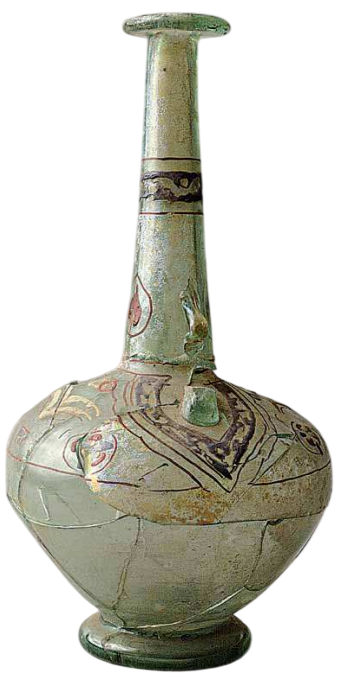
The vessel is distinguished by its expressive and monumental form: the squat, almost spherical body transitions smoothly, yet quite sharply, into an excessively elongated, narrow cylindrical neck, which gives the silhouette a vertical orientation. The composition is completed by a flat horizontal rim.The decoration is executed using the complex technique of painting with coloured enamels and gilding, which indicates that the piece belongs to the category of prestigious, possibly court or elite tableware.The ornamental scheme is organised according to a frieze principle, with a clear division of the surface. The neck is decorated with horizontal bands featuring plant motifs. Particular attention is drawn to the delicate graphic rendering of the details: red enamel is used for the outlines and graceful scrolls.The main focus of the composition is on the body, where large medallions or figurative cartouches are placed, forming the central decorative field.