Traditional and contemporary art of Kazakhstan

A Virtual Journey into the World of Kazakhstan’s Artistic Heritage

This Web Gallery presents the diversity of artistic practices in Kazakhstan, reflecting the continuity of cultural traditions and the dynamic development of contemporary creative processes. The virtual exhibition features works based on national images, symbols, and themes, as well as artworks by contemporary artists who reinterpret the country’s cultural heritage through contemporary artistic forms, expressive means, and modern technologies.

The selected works demonstrate the relationship between traditional and contemporary art, revealing the distinctive features of the national worldview, cultural identity, and cultural meanings. The presented materials allow viewers to trace how elements of historical and cultural heritage are reflected in contemporary artistic practice, while maintaining their significance and relevance in an increasingly globalized world.

The Web Gallery is aimed at promoting Kazakhstan’s artistic heritage, expanding public access to works of art, and fostering a lasting interest in national culture and art among a wide audience.

Sharshy Kilem, 20th c.

2nd half of the 20th century. South Kazakhstan Region. Wool yarn, cotton threads, pile weaving. 200×300 cm. KP 18900 (Alimbay, 61)
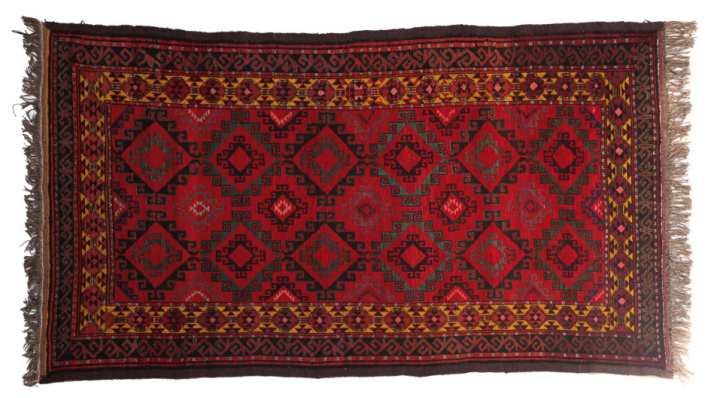
Scholars have identified various types of ‘qaly kilem’ based on the patterns of the central field: ‘sharshy kilem’, ‘samauryn kilem’, ‘shatyrgul kilem’ (or ‘zhuldyzgul kilem’), ‘gulkumbezdi kilem’ and others (Mukanov, 1979). All these ornamental motifs, which are key structural elements of the ‘qaly kilem’ composition, are characteristic exclusively of carpets from the southern regions, primarily the modern Turkestan and Kyzylorda regions.The photograph shown here depicts a pile carpet with diamond-shaped patterns, from which it derives its name ‘sharshy kilem’. It is noteworthy that the pattern is formed not only by the main figure – the diamond (sharshy) – but also through the use of meander scrolls, which can be traced back to Andronovo pottery. The outer border of the carpet is decorated with A-type meander figures according to S.V. Zotova (Zotova, 1965).