
Pileless carpet, 1954
1954. Almaty Region. Designer: N. M. Kapizova Altynkul. Collection of the A. Kasteev State Museum of the Republic of Kazakhstan.
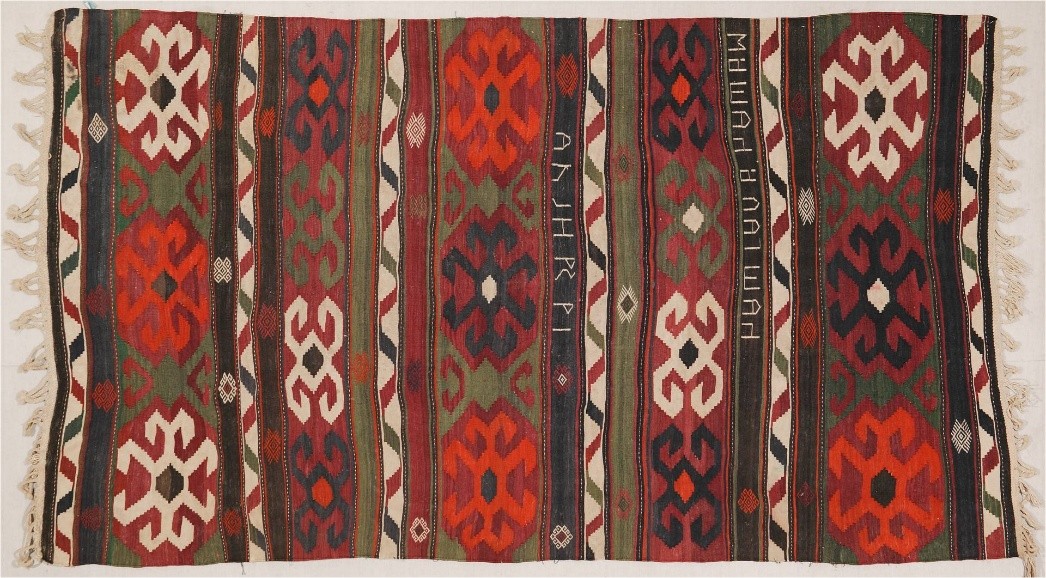
The composition of this carpet, as in the ‘Araby Kilem’, is based on a vertical alternation of bands of varying widths. The central position is occupied by a large, intricate figure with scrolls, executed by the weaver in a contrasting colour scheme — white, red and black. This combination enhances the decorative expressiveness of the ornament and emphasises its compositional dominance.Diamond-shaped motifs are placed at regular intervals along the narrow bands. In some cases, these are diamonds with a characteristic ‘hook-shaped’ projection; in others, they are diamonds filled with a mesh pattern. These elements create the rhythmic structure of the ornamental field.Of particular significance are the narrow white bands, on which a geometrised wave-like pattern is woven. It introduces dynamism and plasticity into the austere vertical composition, softening the overall graphic nature of the design.Semantically, the carpet’s ornamentation may represent a complex symbolic system, where the central motif embodies the axis of the world or the principle of life, the diamond-shaped elements represent fertility and protection, and the wave-like pattern conveys the idea of movement and renewal.