
Kerme, 1980s of the 20th c.
1980s. Mangystau Region. Collection of the Central State Museum of Kazakhstan
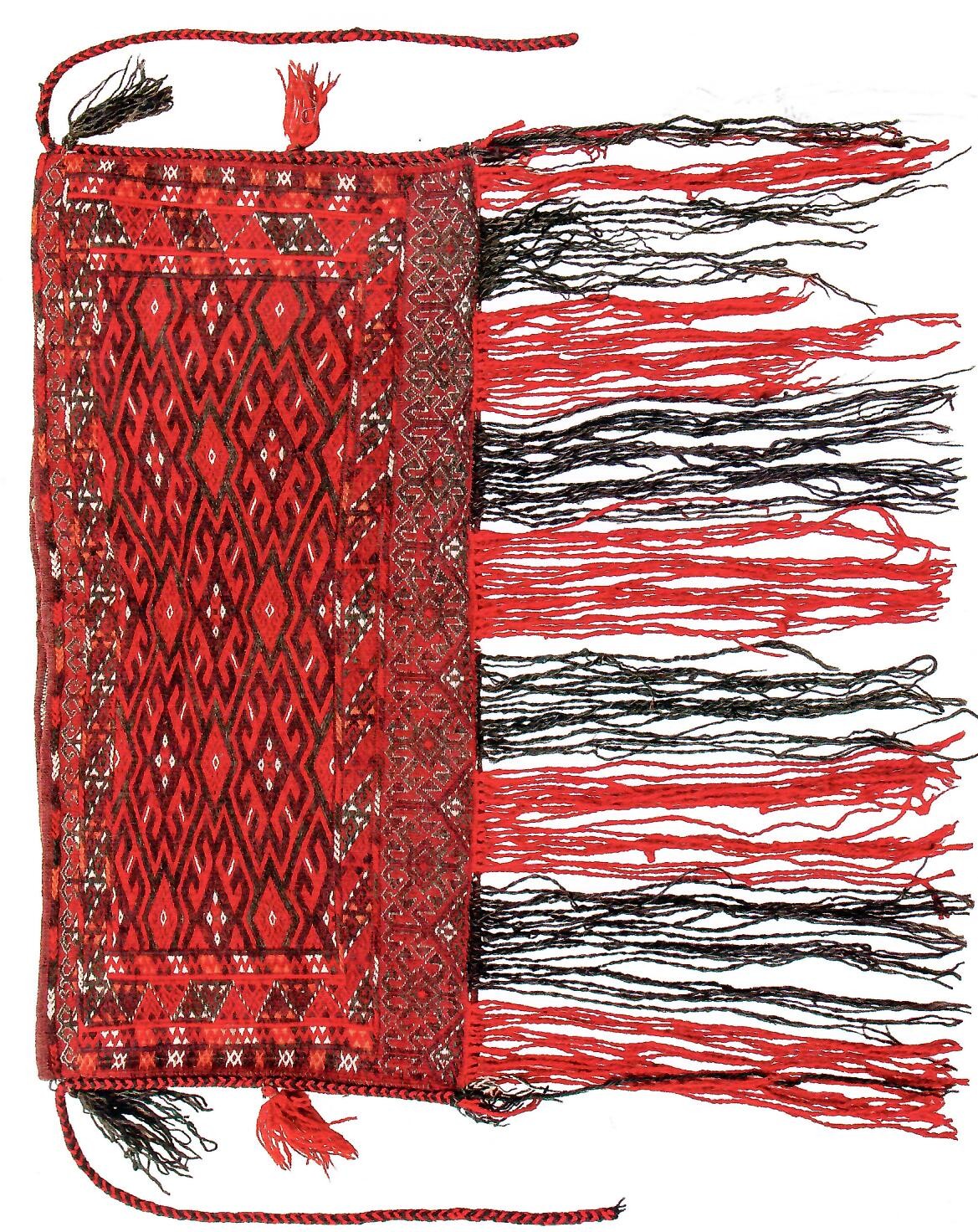
Kerme — a traditional bag for storing household items, serving both a utilitarian and decorative function within the yurt’s interior. This example is made using the lint-free weaving technique. The front side is designed in the style of a carpet, with a clear distinction between the central field and the border.The central field is covered with a sharshy pattern (diamond, square), within which ormekshi (‘spider’) motifs are inscribed. The diamond-shaped structure organises the composition, lending it stability and rhythmic completeness. In traditional semantics, the sharshy is associated with the earth, fertility and an ordered space. The ormekshi motif is linked to the idea of weaving, connection and the continuity of existence.The borders are decorated with ‘tis’ (‘teeth’) and ‘tumarsha’ patterns. The serrated ornament serves a protective function, forming a symbolic boundary, whilst the ‘tumarsha’ (amulet) reinforces the protective meaning of the artefact.Overall, the kerme is not merely a storage vessel, but an artistically crafted object with pronounced protective symbolism.