
Bedspread 20th c.
Collection of the State Museum of the Republic of Kazakhstan. First half of the 20th century. • 168-tk. Northern Kazakhstan. • Folk artist Kuanysheva Zhamila • Velvet, satin, beads, sequins, braid, cord, gold embroidery
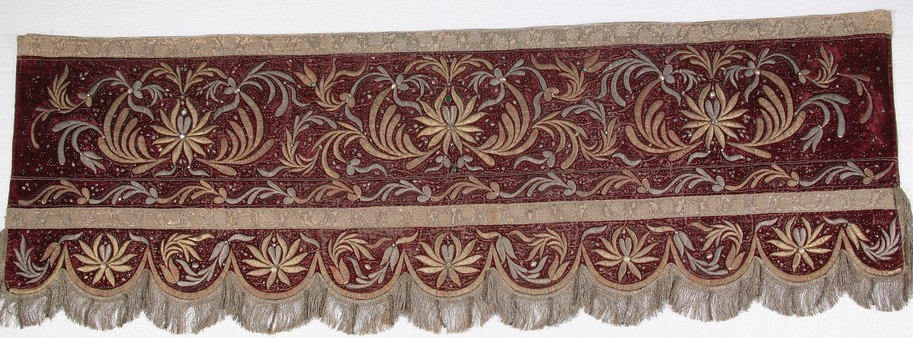
The item is made of velvet and satin and decorated with decorative elements — beads, sequins, braid and cord. The embroidery is executed in gold thread, which lends the composition a special solemnity and decorative expressiveness. The use of such materials is characteristic of ceremonial textiles intended for decorating a lavish yurt. The composition is structured according to a horizontal frieze principle. The ornamental surface is organised as an elongated band filled with repeating floral motifs, which form a rhythmic sequence along the entire length of the piece. The main decorative band is in the upper part and consists of large stylised floral elements and curved plant shoots.The lower part of the piece is finished with a scalloped edge. Each scallop is decorated with stylised floral rosettes and plant elements. Additional decorative effect is provided by the fringe, which enhances the plastic expressiveness of the edge and completes the composition.The ornamentation has a distinctly botanical character. The main elements are stylised flowers, leaves and gently curving stems, forming a complex ornamental network. The botanical motifs form symmetrical compositions and are repeated with a certain rhythm.