
Kasaba 20th c.
Women’s headdress. 20th century. Aktobe Museum of Local History
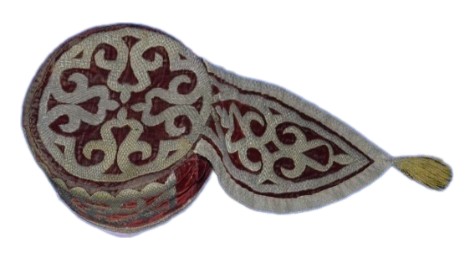
The base of the piece is made of an expensive fabric — red velvet — which gives the headdress an elegant and ceremonial appearance. The kasaba’s construction comprises frontal, parietal and occipital sections, forming an elongated shape with an extended rear element. The entire surface of the headdress is decorated with embroidery created by twisting coloured threads. This technique allows for the creation of raised ornamental lines and emphasises the decorative expressiveness of the pattern.The ornamental composition is symmetrical and features traditional Kazakh motifs in the form of flowing scrolls and plant elements. The main decorative focus is on the forehead and upper parts of the headdress, where large ornamental forms are placed within rounded and elongated contours. Such patterns reflect a striving for harmony, rhythm and the stylisation of natural forms.The elongated rear section of the kasaba is finished with a decorative tassel, which serves as an additional embellishment. The colour scheme is based on the contrast between the red velvet background and the light-coloured embroidery, thanks to which the ornament stands out clearly against the fabric.