Traditional and contemporary art of Kazakhstan

A Virtual Journey into the World of Kazakhstan’s Artistic Heritage

This Web Gallery presents the diversity of artistic practices in Kazakhstan, reflecting the continuity of cultural traditions and the dynamic development of contemporary creative processes. The virtual exhibition features works based on national images, symbols, and themes, as well as artworks by contemporary artists who reinterpret the country’s cultural heritage through contemporary artistic forms, expressive means, and modern technologies.

The selected works demonstrate the relationship between traditional and contemporary art, revealing the distinctive features of the national worldview, cultural identity, and cultural meanings. The presented materials allow viewers to trace how elements of historical and cultural heritage are reflected in contemporary artistic practice, while maintaining their significance and relevance in an increasingly globalized world.

The Web Gallery is aimed at promoting Kazakhstan’s artistic heritage, expanding public access to works of art, and fostering a lasting interest in national culture and art among a wide audience.

Kobyz

Ykylas Museum of Musical Instruments
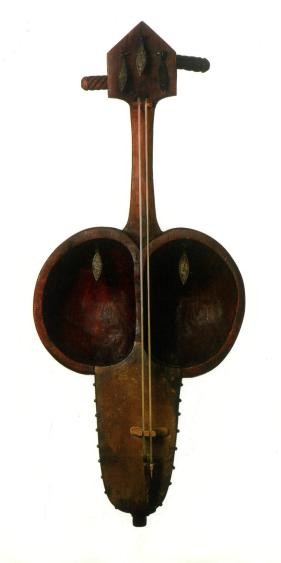
The kobuz is a stringed bowed instrument of ancient sacred origin, “whose sound is polyphonic, similar to the human voice, and intended for philosophical reflection” (Naurzbaeva).Its legendary creator is considered to be Korkyt, an akyn, storyteller and musician, the first baksy, creator of the kuyev (c. 10th–11th centuries). The kobyz (also known as kyl kobyz or nar kobyz) was made from a single piece of wood (apricot, juniper, walnut, birch, etc.), from which an open double or elongated scoop-shaped body, a straight or curved neck (fretboard) and a flat head were carved. The Ykylas Dukenuly Museum of Musical Instruments (Almaty) exhibits collections of kobyz and dombra, the earliest of which have simple forms and no decoration.