
Tagara with a three-colored pattern. 18th–19th centuries. Kultobe settlement
18th–19th centuries. Kultobe settlement. Photo by E.S. Kazizova
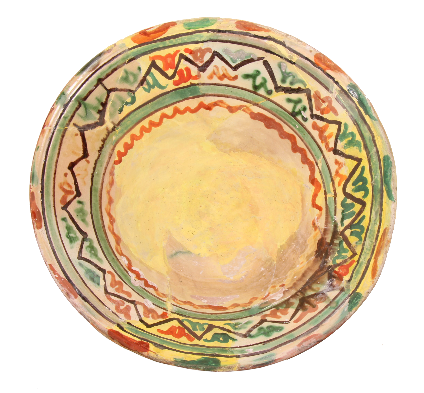
A ceramic tagara, covered in yellow glaze with a three-colour painted design, dates from the 18th–19th centuries. The object measures 42 cm in diameter and 15.1 cm in height. It was discovered at one of the sites of the Kultobe settlement, interpreted as a zikr-khana (17th–18th centuries) — a room for the spiritual and religious practices of the Sufi community.Despite a certain coarseness of form, the vessel is distinguished by its originality. The polychrome painting beneath the transparent lemon-yellow glaze is characterised by the richness and expressiveness of the brushstrokes: drips, S-shaped marks, short lines, M-shaped forms, and zigzags. Their combination forms a distinctive composition.Colour enhanced the artistic expressiveness and served a symbolic function. The predominance of yellow is likely linked to the Sufi tradition (zakhir-batin), where it corresponds to the second stage of the path (tarikat) and the symbolism of the sun as divine radiance.