
Qamshy
Photo from el.kz website
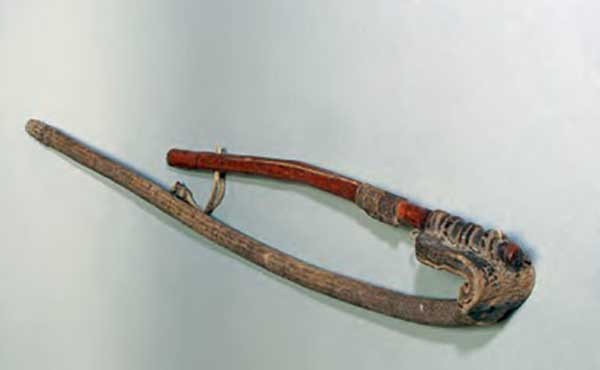
KAMSHY is a traditional Kazakh woven whip, but its significance in Kazakh culture goes far beyond that of a simple tool for controlling livestock. It is usually made from rawhide (most often ox or camel). It can be single-tailed or multi-tailed, with a handle often decorated with carvings, metal, silver, fur or beads.In ancient times, cattle hides were first soaked in ayran and sprinkled with salt. Every two or three days, it was thoroughly mixed. This process continued for almost a month, after which the wool came off easily. The skin was then processed on a wooden machine and carefully smoothed. For further use, it was cut into leather strips, which could be four, six, eight or ten in number.In Kazakh culture, there was a strict etiquette for handling the kamshy. When entering a yurt or being out of the saddle, a nomad held the whip in his right hand, folded in half, without waving it. When indicating the direction of the road or an object, the rider was shown not with a hand, but with a folded kamcha. It was forbidden to strike the ground, children, the house or felt with the whip.A nomad entered someone else’s yurt without a kamshy in his hands, leaving it in the saddle or hiding it in his boot, and the appearance of a zhigit among girls with a specially crafted or skilfully decorated kamshy raised his status and prestige in society. The whip also served as a talisman: it was believed that the whip was impregnated with the horse’s sweat, and evil forces were afraid to approach it. Therefore, it was kept in the house as protection against bad people and evil spirits. Our ancestors believed that the whip had power: if placed under a child’s pillow, it would ward off all troubles and misfortunes.