
Shashbau
Hair ornament. Late 19th century. Kyzylorda region. Silver, granulation, filigree, stamping. A. Kasteyev National Museum of Arts of the Republic of Kazakhstan
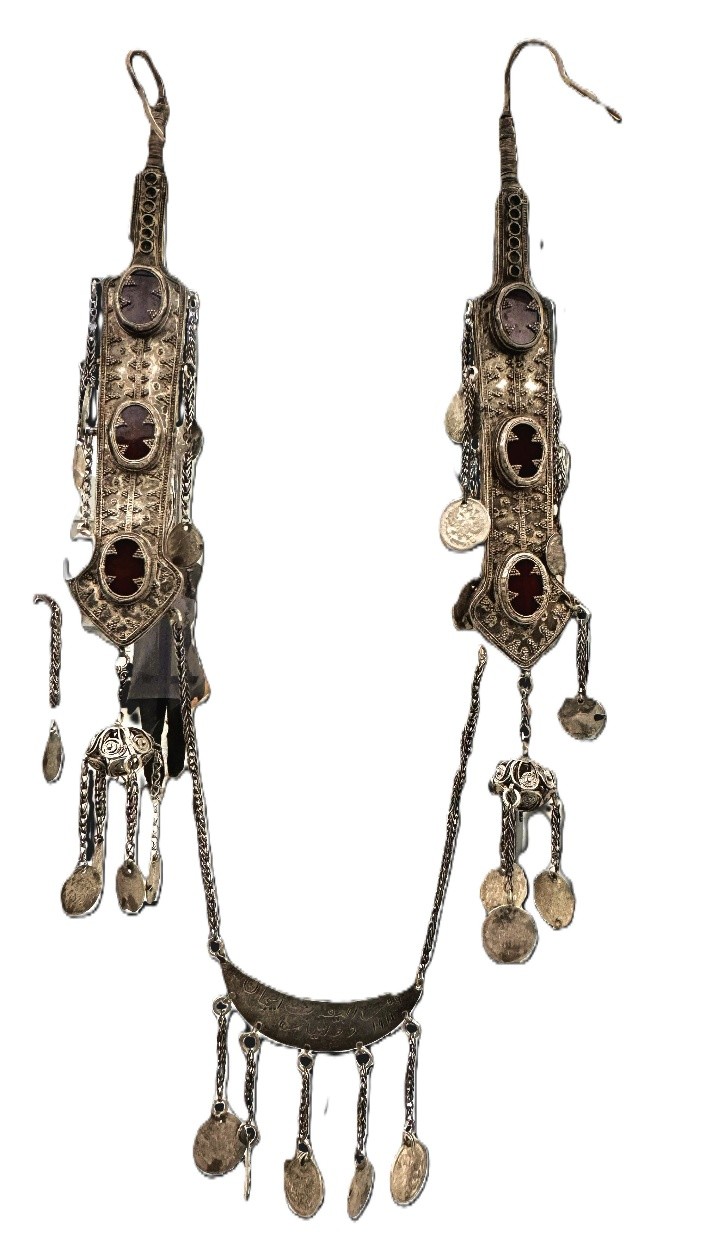
Shashbau, a pendant-style hair ornamentThis item is a traditional hair ornament designed to be woven into braids, serving both decorative and protective functions.The design comprises a pair of elongated plates, secured to upper hooks for fastening in the hairstyle. The lower parts of the plates are complemented by intricately shaped pendants featuring chain elements and coin-shaped discs. Both parts are connected by a chain with a central semi-circular element, also fitted with pendants. All elements of the design are movable.The composition is based on a symmetrical-axial principle with a pronounced vertical orientation. The paired plates form two main compositional centres, connected by a lower arched element. The vertical lines of the pendants create a rhythmic structure that emphasises the length of the form along the line of the braids.The ornamental system combines geometric and botanical motifs. The surfaces of the plates are decorated with a filigree pattern incorporating oval inserts of coloured material. The grained decoration emphasises the contours and enhances the textural richness. The suspensions are designed in the form of chains and coin-like elements, creating an additional rhythm.The pendant elements allow for active movement and produce a sound effect when in motion. Overall, the piece demonstrates a combination characteristic of the southern regions of Kazakhstan: an elongated composition, a complex structure, and amuletic symbolism associated with the protection and adornment of hair.