
Earrings
South Kazakhstan. Silver, coral, turquoise, bending, carving, embossing. A. Kasteyev National Museum of Arts of the Republic of Kazakhstan
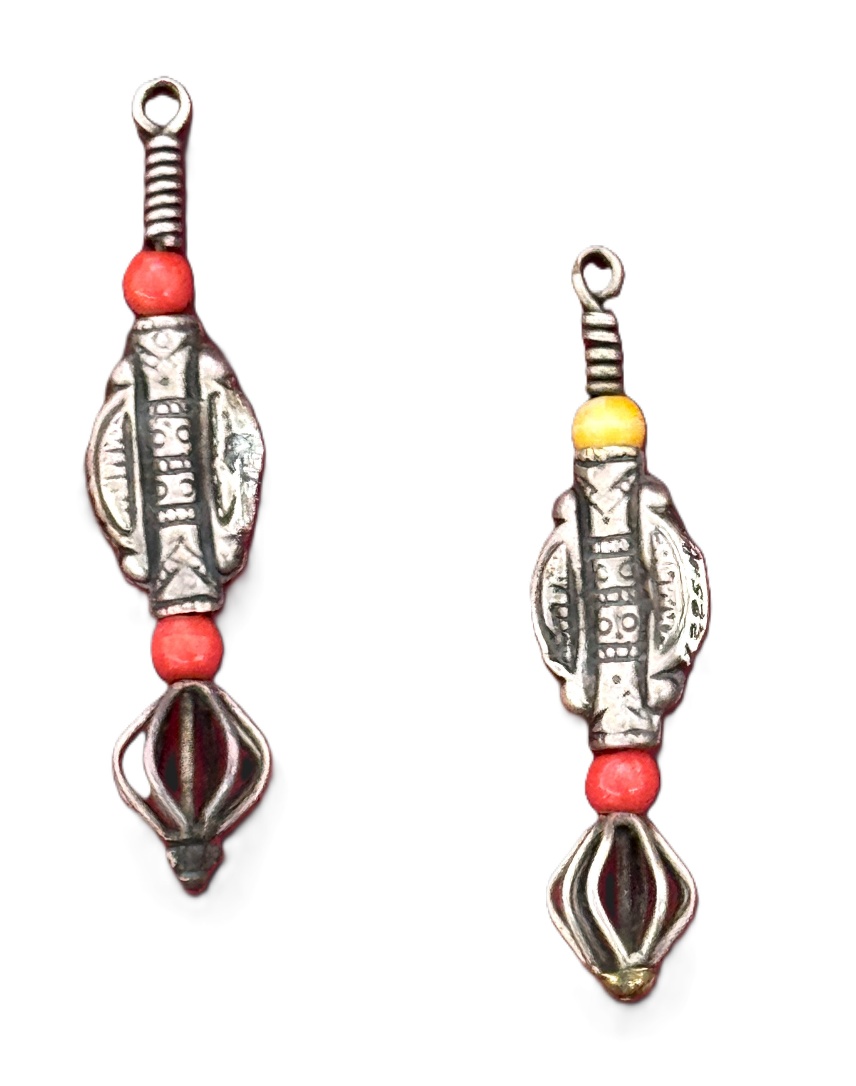
Syrga are complex drop earrings characteristic of the 20th-century jewellery tradition of South Kazakhstan. The piece is classified as ceremonial jewellery and is distinguished by its pronounced dynamic form.The material is silver; decorative elements include inlays of coral and, probably, glass or stone beads. The technique combines bending, chasing and carving, creating an openwork and relief structure.The design consists of a multi-part hanging system attached to a hook-shaped clasp. The upper element is an openwork plate featuring a central shield-shaped motif. Attached to the lower part are several vertical pendants, consisting of metal rods strung with beads and ending in conical elements.The composition is constructed along an axial principle with a clear vertical orientation. The upper part serves as the compositional centre, from which rhythmically organised pendants extend downwards. The alternation of cylindrical beads and conical finials creates an expressive rhythm and enhances the visual dynamism of the piece.The ornamental scheme combines geometric and stylised motifs. The central element features a concise ornament inscribed within a shield-like shape. The suspended conical elements produce a sound effect when in motion, enhancing the decorative impact. The contrast between the metal and the coral inlays lends the piece expressiveness and emphasises its ceremonial character.