
Ongirzhiek
19th-century breast ornament. West Kazakhstan. Silver, gilding, stamp, glass. A. Kasteyev National Museum of Arts of the Republic of Kazakhstan
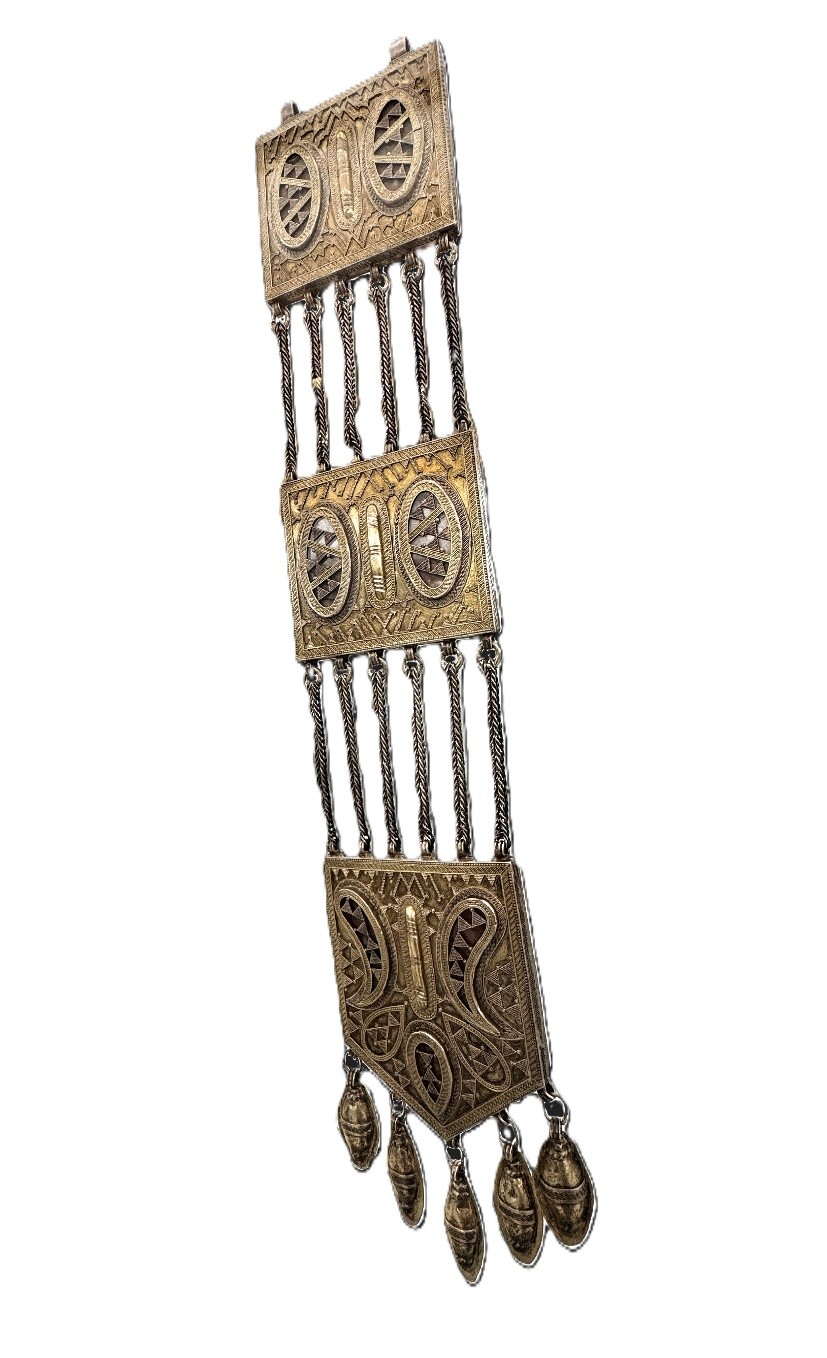
Ongirzhiek, a plate-and-pendant-style breast ornament. The artefact belongs to the category of ceremonial and status-symbol neck and chest ornaments that formed part of women’s attire and served both decorative and protective functions.The design consists of a vertically oriented composite structure made up of three rectangular plates connected by chain links. The upper plate is fitted with fastenings for suspension. The lower part is finished with a system of pendants featuring teardrop-shaped elements. The connecting chains ensure the structure’s mobility.The composition is built on a strictly axial principle with a pronounced vertical orientation. The plates are arranged sequentially, forming an elongated shape accentuated by the rhythmic vertical lines of the chains. Each plate has its own ornamental centre, yet the entire composition is perceived as a unified whole thanks to the repetition of motifs and symmetry.The ornamental scheme combines geometric and stylised floral motifs. The surface of the plates is filled with stamped ornamentation featuring oval medallions and linear, zigzag-shaped elements. The central glass inlays serve as colour accents and emphasise the compositional centres. The gilding enhances the decorative expressiveness and creates a contrast with the main silver background.The pendant elements serve a decorative and acoustic function, creating movement and a sound effect when worn. Overall, the piece demonstrates the complex multi-part structure and rich ornamentation characteristic of the West Kazakh tradition, reflecting the high status and significance of the ornament within the costume ensemble.