
Bilezik
Kyzylorda Region. Silver, enamel, carving, repoussé. A. Kasteyev National Museum of Arts of the Republic of Kazakhstan
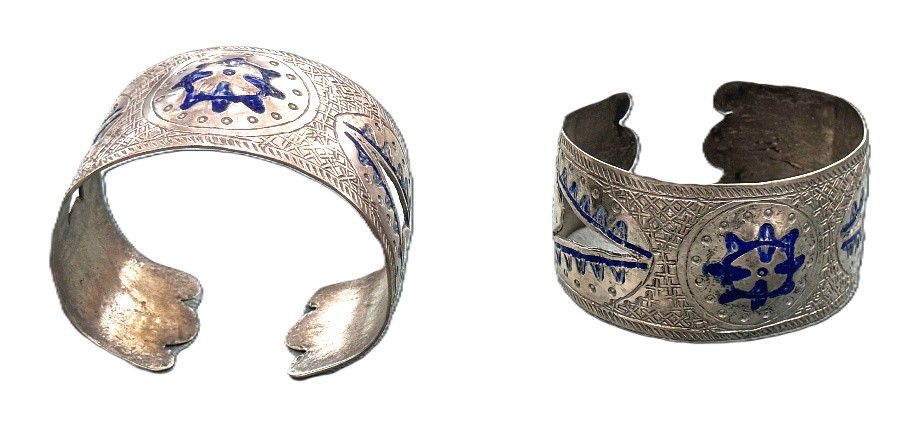
A bilezik is a traditional type of wrist ornament, common in Kazakh jewellery art of the 19th–20th centuries. The piece belongs to the category of everyday and ceremonial jewellery and served both a decorative and a status-symbolic function.The material is silver; the techniques used include repoussé, engraving and the use of coloured enamel. The use of enamel, particularly a rich blue colour, enhances the decorative expressiveness of the piece and creates a colour accent against the metallic surface.The design consists of a wide, open cuff-style bracelet with a thickened upper section. The ends of the bracelet are shaped like stylised, slightly flaring blades, which makes it easier to put on and simultaneously completes the piece’s silhouette. The inner surface remains smooth, whilst the outer surface is richly ornamented.The composition is arranged in a frieze-like pattern with central medallions highlighted. The ornamental scheme is dominated by circular rosette elements filled with blue enamel inlays, which serve as compositional accents. Between the medallions are geometric fields with dense mesh engraving, creating a uniform background and reinforcing the rhythmic organisation of the decoration.The ornamentation combines geometric and solar-rosette motifs. The central elements can be interpreted as stylised solar symbols or floral rosettes, which is characteristic of traditional ornamental design. The contrast between the cool sheen of the silver and the rich blue colour of the enamel lends the piece expressiveness and emphasises its decorative completeness.