
Otau yuzik
Aktobe Region. Silver, granulation, repoussé, stamping. A. Kasteyev National Museum of Arts of the Republic of Kazakhstan
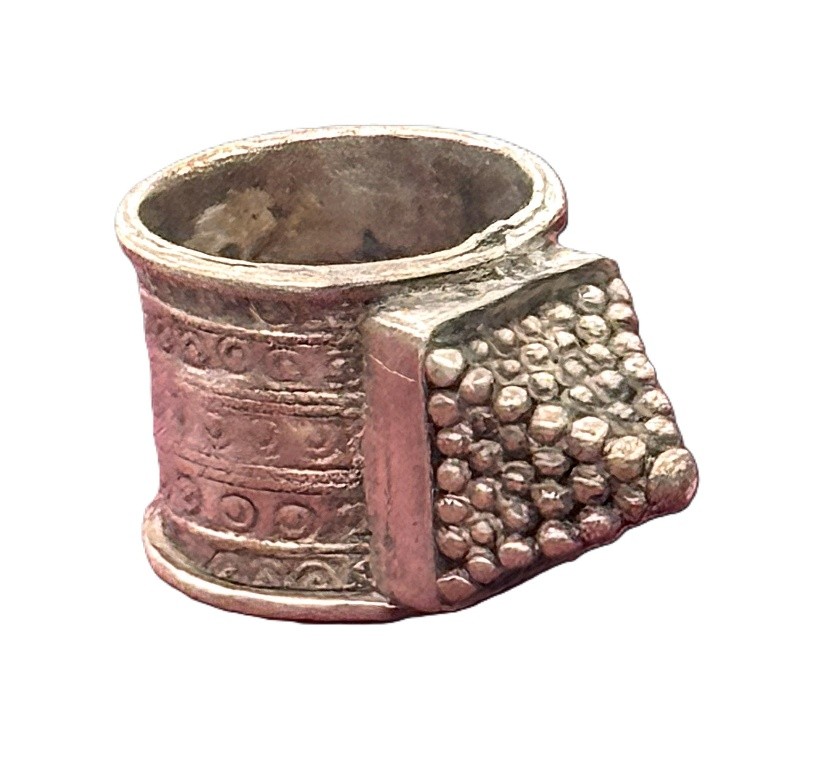
Ring (juzik), ‘otau juzik’ type (with a solid shield). The ring belongs to the category of traditional women’s jewellery of a status-symbolic and ritual nature, associated with the complex of wedding culture (the image of the ‘otau’ — the young family).The design comprises a wide, cylindrical band with a thickened upper section that transitions into a solid shield. The shield is trapezoidal-rectangular in shape and protrudes significantly above the main surface of the ring. The surface of the shield is covered with dense granulation, creating a relief texture.The composition is based on the contrast between smooth and richly decorated areas. The shank is organised into frieze-like ornamental bands alternating geometric and scroll motifs, whilst the shield acts as the dominant compositional centre. Its massiveness and textural richness emphasise the frontal orientation and visual weight of the upper part of the piece.The ornamental scheme combines geometric and stylised plant motifs. The granulation decoration on the shield forms a surface rich in associations, reinforcing the symbolic significance of the piece. In traditional interpretation, such forms are associated with notions of prosperity, stability and protection, which corresponds to the ring’s function as a symbol of wedding and family status.