
Toothpick and ear cleaner
Kyzylorda region. Silver, smalt, engraving, casting, stamping. A. Kasteev National Museum of Arts of the Republic of Kazakhstan
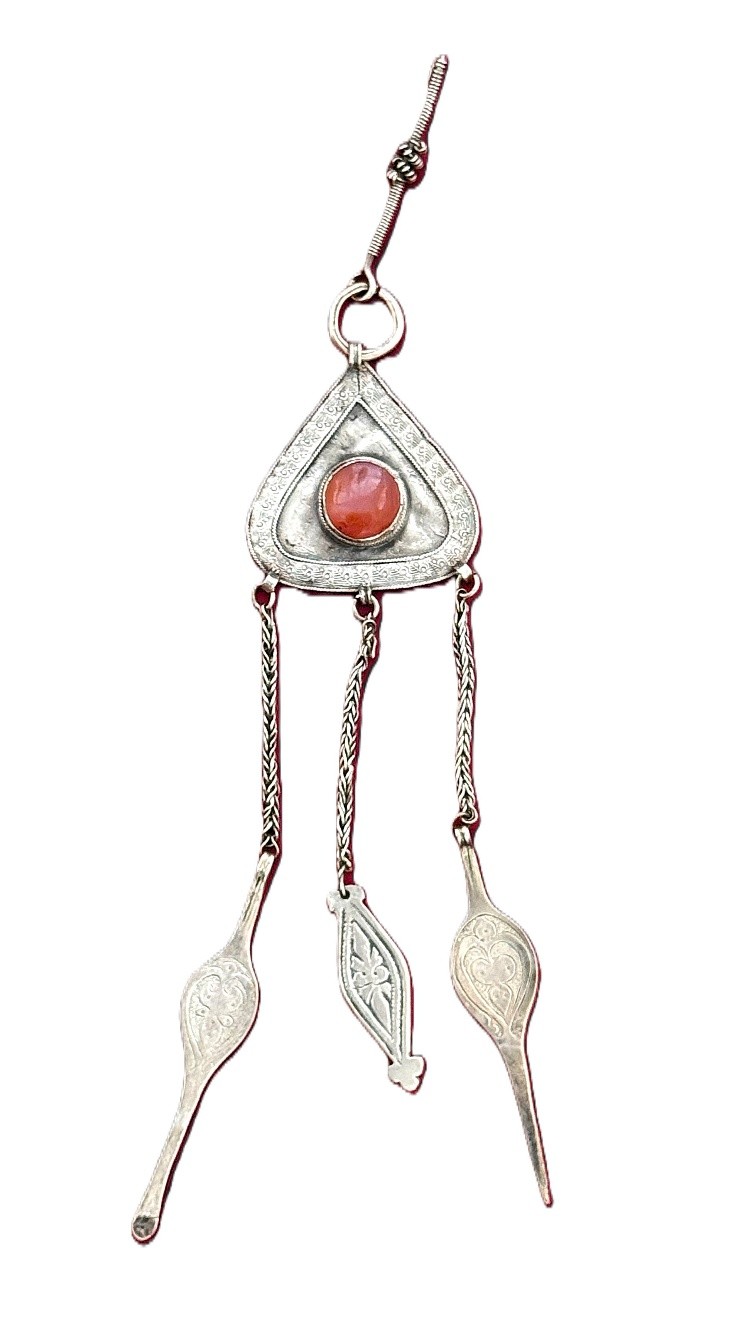
Tis shuqygysh, kulaq tazalagysh (Toothpick and ear cleaner).The item is a suspended, multi-functional household set comprising personal hygiene tools — a toothpick and an ear pick — combined into a single decorative composition.The base consists of a triangular pendant with rounded sides, in the centre of which is an insert made of red material (probably smalt or glass), set in a socket with a smooth frame. The surface of the plate is decorated with an engraved pattern along the edge, forming a closed frame composition.Three braided chains extend from the lower part of the pendant, carrying functional elements. The terminal tools are executed in an elongated spoon-like shape with pointed and widened working parts. Their surfaces are decorated with engraved plant motifs, stylistically consistent with the central element.Compositionally, the piece is constructed along a vertical axis with pronounced symmetry. The upper suspended section features a ring and a spiral fastening, allowing it to be attached to a belt or clothing. A sense of movement is created by the mobility of the suspended elements, enhancing the visual and auditory expressiveness.Technologically, the piece combines the casting of basic forms, followed by the stamping of decorative elements and surface engraving. The movable joints are formed using rings and chains.This item belongs to the category of everyday objects with a pronounced decorative function and reflects the tradition of integrating utilitarian objects into the system of jewellery adornment, characteristic of Kazakh culture in the late 19th century.