
Spring, 2024. Aluminium.
Alibek Mergen
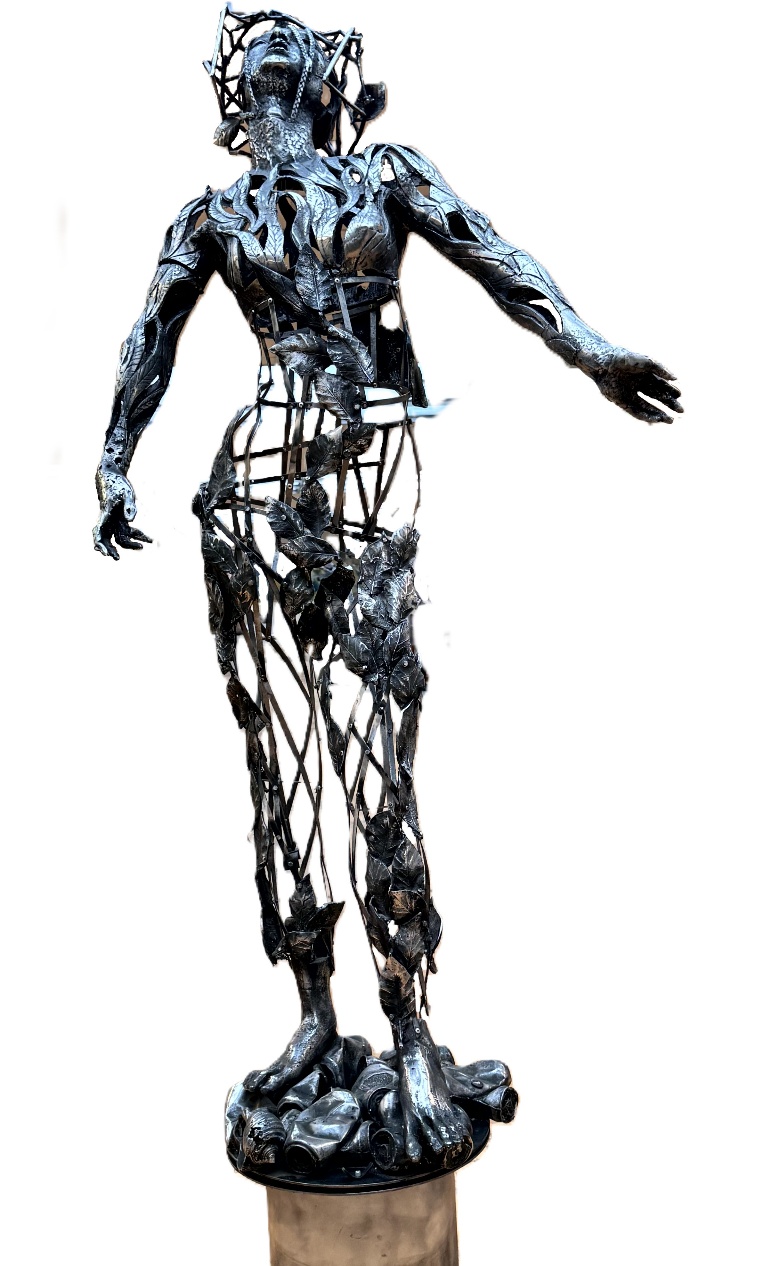
The work features a figurative composition in which the plasticity of the human body is combined with the principles of constructive openness and organic transformation of form. The use of aluminium allows for visual lightness and spatial transparency of the structure, whilst maintaining the stability of the silhouette and the clarity of the compositional structure.The figure is interpreted not as a solid volume, but as a system of intersecting metal elements forming a skeletal framework. This approach shifts the focus from mass to space, where voids become an integral part of the sculptural language. Within this structure, motifs reminiscent of plant shoots and organic growths develop, thanks to which the human form is perceived as part of a natural process.The vertically elongated composition is built on the dynamics of an open gesture: the torso is slightly tilted back, the arms are spread out to the sides, and the tilted head reinforces the sense of inner elevation and upward movement. This positioning of the figure evokes associations of liberation and spiritual revelation. At the same time, the open structure of the body creates a tension between the physical shell and the inner void, transforming the space within the sculpture into a significant expressive element.The textural treatment of the work plays a special role. Smooth metal surfaces are combined with relief-like, almost biomorphic elements, allowing light to interact actively with the sculpture’s form. As the viewing angle changes, the sculpture takes on a shifting character, transitioning from structural clarity to a sense of living, organic movement.The work’s thematic content is linked to the idea of renewal, growth and the constant flux of existence. The human figure, as if sprouting from natural forms, is interpreted as a metaphor for the unity of humanity and the surrounding world, the cyclical nature of life and inner rebirth. In this context, the title ‘Spring’ transcends its literal seasonal meaning and takes on a philosophical resonance, signifying a state of transition, renewal and spiritual awakening.The work demonstrates the characteristic features of contemporary Kazakhstani sculpture, which combines figurative elements, aspects of abstract plastic arts and a constructive approach to the organisation of form. The sculpture is perceived not only as a three-dimensional object, but also as a spatial metaphor revealing the complex interrelationships between nature, humanity and the inner state.