
‘Camel’ and ‘Little Horse’Material: metal, polyester resin, fibreglassLocation: Almaty, Abay Avenue, between Zharokov Street and Gagarin AvenueSource: U. Fatyanova, ‘Almaty: 14 Most Interesting Landmarks’ (2018)
Centre for Young Artists (Kazakhstan)
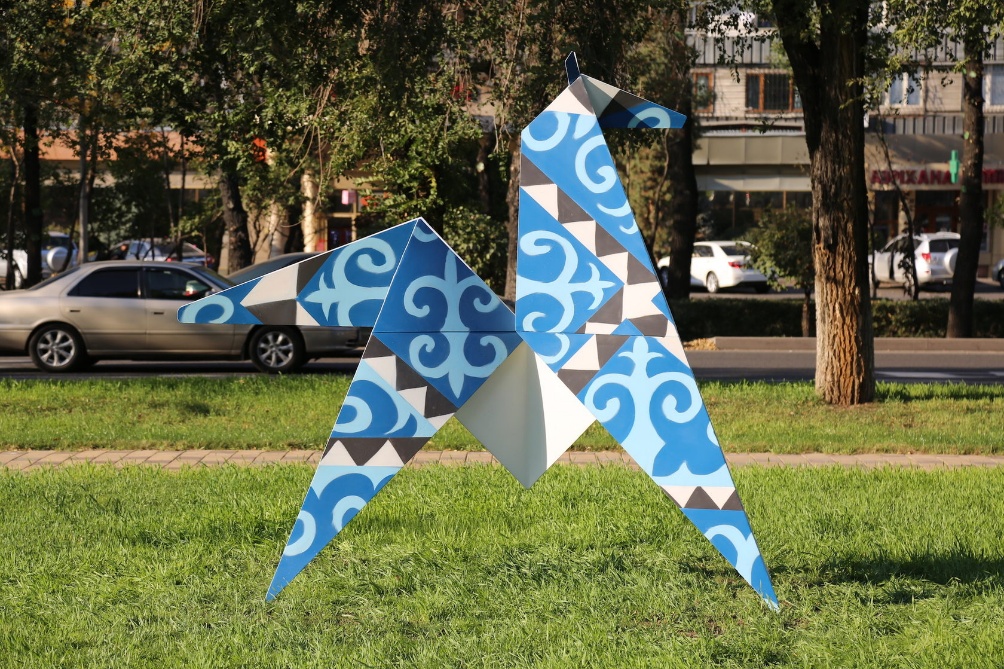
Both sculptures are based on highly abstracted animal silhouettes, which are easily recognisable thanks to their distinctive contours. The artists eschew a naturalistic rendering of form, reducing the image to a system of geometrised planes and facets. This approach brings the works closer to the aesthetics of origami, Constructivism and polygonal sculpture, where the primary means of expression is not the modelling of volume, but the interplay of planes. The artists were inspired to undertake this experiment by the artist Logan Boulevard, who created a giant origami crane, writes U. Fatyanova. The decorative treatment of the surfaces plays a particular role. The sculptures are covered with ornamental compositions reminiscent of motifs from traditional Kazakh qurak qurau. The surfaces are divided into multicoloured geometric segments, forming something akin to a patchwork quilt. As a result, the structure is perceived not only as a depiction of an animal, but also as a three-dimensional visualisation of traditional textile art.The design of ‘The Little Horse’ is dominated by shades of blue and scroll motifs, reminiscent of the ‘qoshqar muiz’ ornament, which symbolises well-being, vitality and prosperity. The ‘Camel’ design features rich reds and yellows.It is highly likely that the choice of animal motifs is no coincidence. In traditional culture, the horse is a symbol of freedom, movement, military valour and spiritual independence. The camel is associated with wealth, well-being and the stability of the economic way of life.