
Saukele (bride’s headdress), 2013, silver, gilding, carnelian, coral, sable fur, velour; stamping, filigree. A. Kasteev National Museum of Arts of the Republic of Kazakhstan
Estay Daubaev
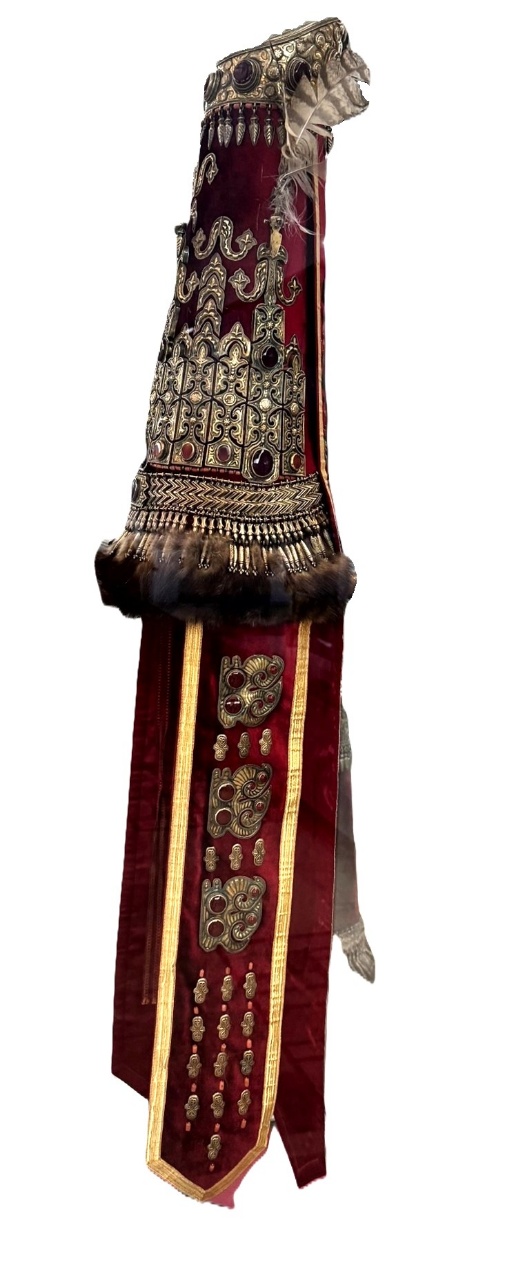
The piece is a traditional wedding headdress — a saukele — reinterpreted within the framework of contemporary artistic practice whilst retaining its canonical structure. The design is characterised by an elongated conical shape, visually emphasising the vertical axis and symbolising the bride’s transitional status. The lower part is complemented by textile pendants and a fur trim, forming a complete compositional system.The form is based on a combination of a rigid frame and soft textile elements, creating a contrast of materials and enhancing the object’s sculptural expressiveness. The surface is richly decorated with metal inlays, executed using stamping and filigree techniques, incorporating carnelian and coral inserts. The ornamental structure is frieze-like in character and organised in tiers.Semiotically, the piece reproduces key elements of the traditional worldview: the vertical is interpreted as the axis of sacred ascent, whilst the use of stones (carnelian, coral) refers to the apotropaic function of protection. The suspended elements enhance the object’s dynamism and are linked to the idea of movement and the cycle of life.In the context of contemporary jewellery art, the work demonstrates a strategy of ethnomodernism, in which the traditional form is not reconstructed literally, but artistically interpreted through an intensification of decorative richness and material expressiveness. In this instance, the saukele functions not only as an ethnographic artefact, but also as an independent artistic object representing cultural memory and identity.