Traditional and contemporary art of Kazakhstan

A Virtual Journey into the World of Kazakhstan’s Artistic Heritage

This Web Gallery presents the diversity of artistic practices in Kazakhstan, reflecting the continuity of cultural traditions and the dynamic development of contemporary creative processes. The virtual exhibition features works based on national images, symbols, and themes, as well as artworks by contemporary artists who reinterpret the country’s cultural heritage through contemporary artistic forms, expressive means, and modern technologies.

The selected works demonstrate the relationship between traditional and contemporary art, revealing the distinctive features of the national worldview, cultural identity, and cultural meanings. The presented materials allow viewers to trace how elements of historical and cultural heritage are reflected in contemporary artistic practice, while maintaining their significance and relevance in an increasingly globalized world.

The Web Gallery is aimed at promoting Kazakhstan’s artistic heritage, expanding public access to works of art, and fostering a lasting interest in national culture and art among a wide audience.

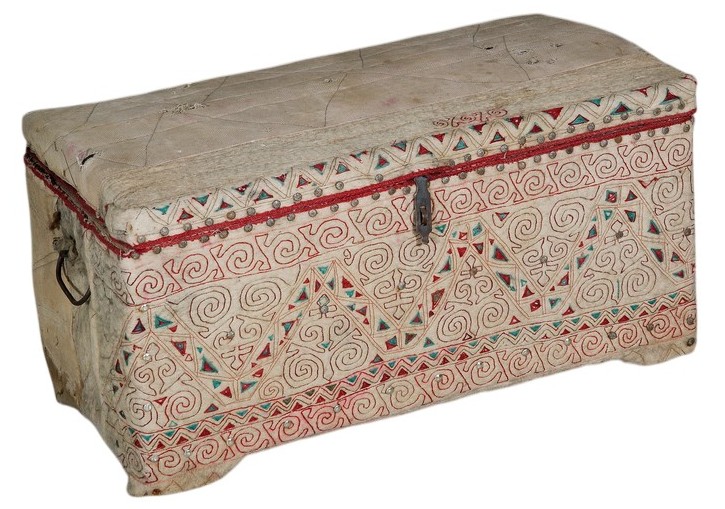
Sandyk Kap, 1950

At-zhabu. Felt, felting, embroidery. 1950. • From the collection of the A. Kasteev National Museum of Arts of the Republic of Kazakhstan (227-b).
This mid-20th-century (1950) at-zhabu (horse blanket) is an important ethnographic artefact that reflects the Kazakh people’s deep reverence for the horse as a sacred animal. The piece is crafted using the traditional felting technique from thick, light-coloured felt. The artistic design of the saddlecloth is characterised by minimalism and austerity. The main emphasis is on the outline embroidery, which lends the composition a sense of clarity. The ornamental motifs, situated along the edges and at the bottom of the piece, represent stylised variations of the “muyiz”. At the bottom of the saddlecloth, a complex fan-shaped pattern can be seen, reminiscent of the tree of life or a stylised bird’s tail, symbolising dynamism and speed.