Traditional and contemporary art of Kazakhstan

A Virtual Journey into the World of Kazakhstan’s Artistic Heritage

This Web Gallery presents the diversity of artistic practices in Kazakhstan, reflecting the continuity of cultural traditions and the dynamic development of contemporary creative processes. The virtual exhibition features works based on national images, symbols, and themes, as well as artworks by contemporary artists who reinterpret the country’s cultural heritage through contemporary artistic forms, expressive means, and modern technologies.

The selected works demonstrate the relationship between traditional and contemporary art, revealing the distinctive features of the national worldview, cultural identity, and cultural meanings. The presented materials allow viewers to trace how elements of historical and cultural heritage are reflected in contemporary artistic practice, while maintaining their significance and relevance in an increasingly globalized world.

The Web Gallery is aimed at promoting Kazakhstan’s artistic heritage, expanding public access to works of art, and fostering a lasting interest in national culture and art among a wide audience.

Ayan, 2007. Oil on canvas. Source: private collection

Kabdyl-Galym Nasyrovich Karzhasov
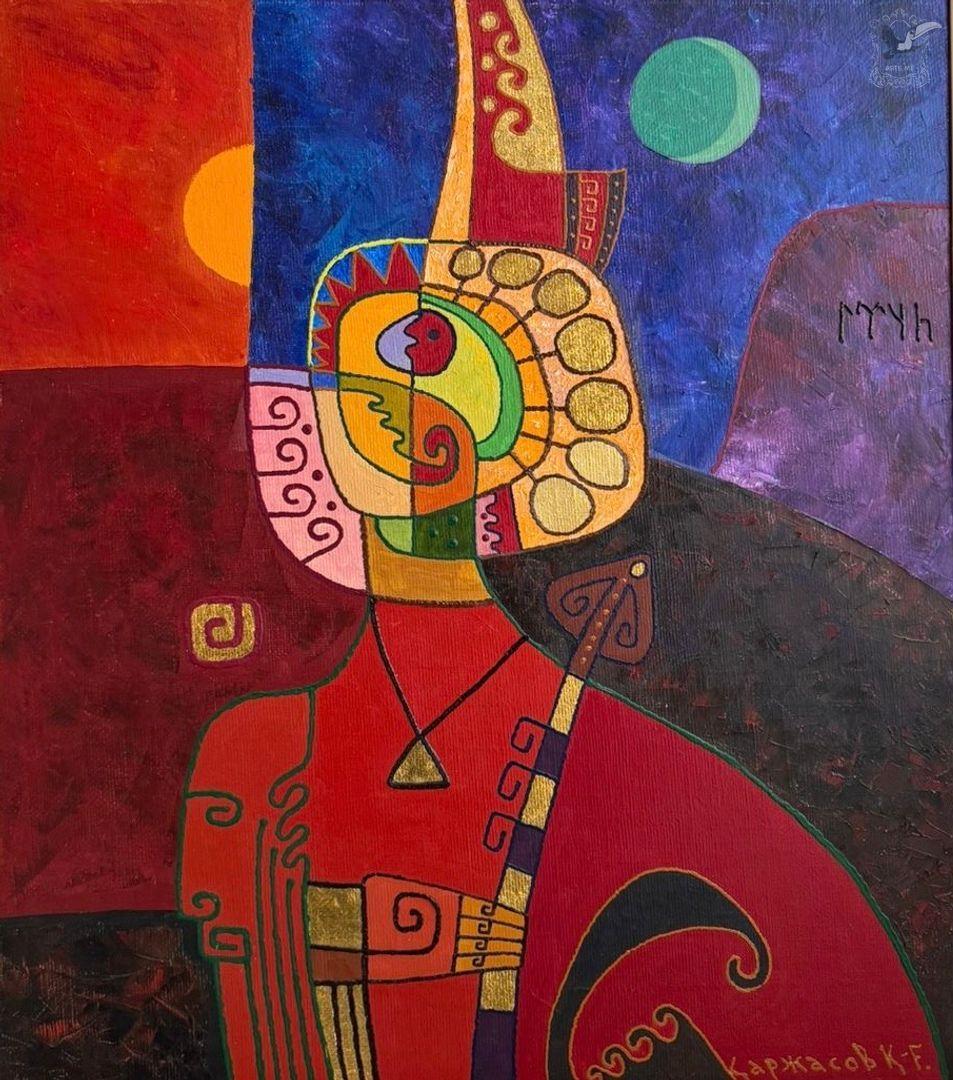
The title ‘Ayan’ translates as ‘vision’, ‘revelation’ or ‘prophetic dream’. In the centre of the canvas is a stylised figure of a sacred character wearing a tall headdress reminiscent of a saukele. The figure’s face is deconstructed into geometric segments, evoking both archaic masks and Cubist techniques.The composition is filled with cosmogonic symbols. On the left is a bright orange sun; on the right, a turquoise moon against a deep blue sky. This arrangement emphasises the idea of the unity of opposites (day and night, the masculine and feminine principles), as well as the character’s connection to the universe. Ancient runic inscriptions on the right-hand side of the canvas enhance the sense of historical and cultural depth.The dominant rich red colour of the clothing symbolises vital energy. The contrast between shades of red, blue, gold and terracotta creates a certain tension and enhances the expressiveness of the image. The use of gold outlines and the flat treatment of forms give the work the character of an ancient ornamental carpet.