Traditional and contemporary art of Kazakhstan

A Virtual Journey into the World of Kazakhstan’s Artistic Heritage

This Web Gallery presents the diversity of artistic practices in Kazakhstan, reflecting the continuity of cultural traditions and the dynamic development of contemporary creative processes. The virtual exhibition features works based on national images, symbols, and themes, as well as artworks by contemporary artists who reinterpret the country’s cultural heritage through contemporary artistic forms, expressive means, and modern technologies.

The selected works demonstrate the relationship between traditional and contemporary art, revealing the distinctive features of the national worldview, cultural identity, and cultural meanings. The presented materials allow viewers to trace how elements of historical and cultural heritage are reflected in contemporary artistic practice, while maintaining their significance and relevance in an increasingly globalized world.

The Web Gallery is aimed at promoting Kazakhstan’s artistic heritage, expanding public access to works of art, and fostering a lasting interest in national culture and art among a wide audience.

Koitas

Koshkar-Ata necropolis. Mangystau Region
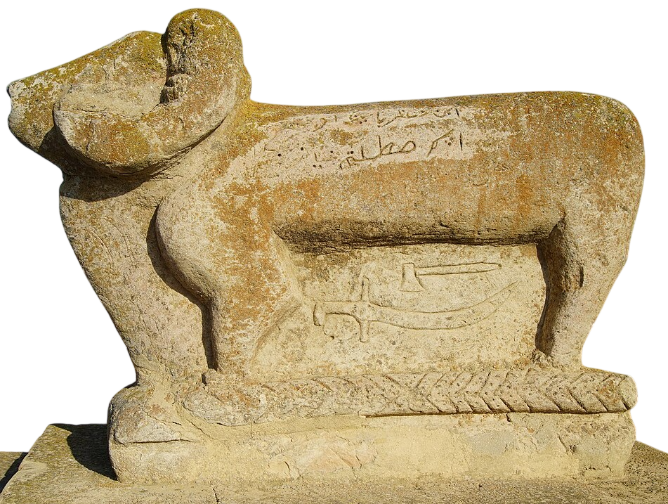
This monument is a classic example of Mangystau memorial sculpture — a koitas — embodying a profound syncretism of pre-Islamic beliefs and Islamic tradition.The artistic design is characterised by the generalised and monumental forms: the craftsman does not strive for anatomical accuracy, focusing instead on the expressive plasticity of the volume. The massive body flows organically into a powerful, shortened neck. Significance is attached to the large, spirally twisted horns, which, in the symbolic system of nomadic culture, are associated with vitality, fertility and heavenly protection.The side surface of the torso is of considerable interest, serving as a kind of ‘narrative field’. Here are placed relief depictions of objects signifying the social status and life path of the deceased — a sabre (kylysh) and an axe (balta).An epigraphic inscription in Arabic script is carved into the upper part of the body.