Traditional and contemporary art of Kazakhstan

A Virtual Journey into the World of Kazakhstan’s Artistic Heritage

This Web Gallery presents the diversity of artistic practices in Kazakhstan, reflecting the continuity of cultural traditions and the dynamic development of contemporary creative processes. The virtual exhibition features works based on national images, symbols, and themes, as well as artworks by contemporary artists who reinterpret the country’s cultural heritage through contemporary artistic forms, expressive means, and modern technologies.

The selected works demonstrate the relationship between traditional and contemporary art, revealing the distinctive features of the national worldview, cultural identity, and cultural meanings. The presented materials allow viewers to trace how elements of historical and cultural heritage are reflected in contemporary artistic practice, while maintaining their significance and relevance in an increasingly globalized world.

The Web Gallery is aimed at promoting Kazakhstan’s artistic heritage, expanding public access to works of art, and fostering a lasting interest in national culture and art among a wide audience.

Tablecloth 20th c.

Turkestan Regional Museum of History and Local Lore
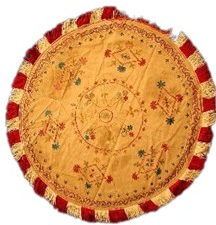
A round tablecloth is made of light brown woollen fabric. The surface of the item is richly ornamented with embroidery executed in coloured threads. The composition is based on the principle of central symmetry: a round medallion is situated in the centre, from which ornamental elements radiate across the entire surface of the piece, forming a harmonious and balanced decorative structure.The ornament features traditional motifs of Kazakh folk art — gul (flower), shyrshyk (scroll), shugyla (ray-like element), ushqula (three-petalled motif), botakoz (an ornament in the shape of a ‘camel’s eye’) and tortkulaq (a cross-shaped or four-petalled element). These patterns form a complex system of plant and geometric forms characteristic of Kazakh decorative and applied art.The colour scheme is based on a combination of red, green and yellow hues, which contrast with the light brown background of the fabric and emphasise the expressiveness of the pattern. The edge of the tablecloth is adorned with a fringe of crimson and yellow silk threads, lending the piece a sense of completeness.