
Bilezik
West Kazakhstan. Silver, blackening, stamping, granulation, engraving. A. Kasteyev National Museum of Arts of the Republic of Kazakhstan
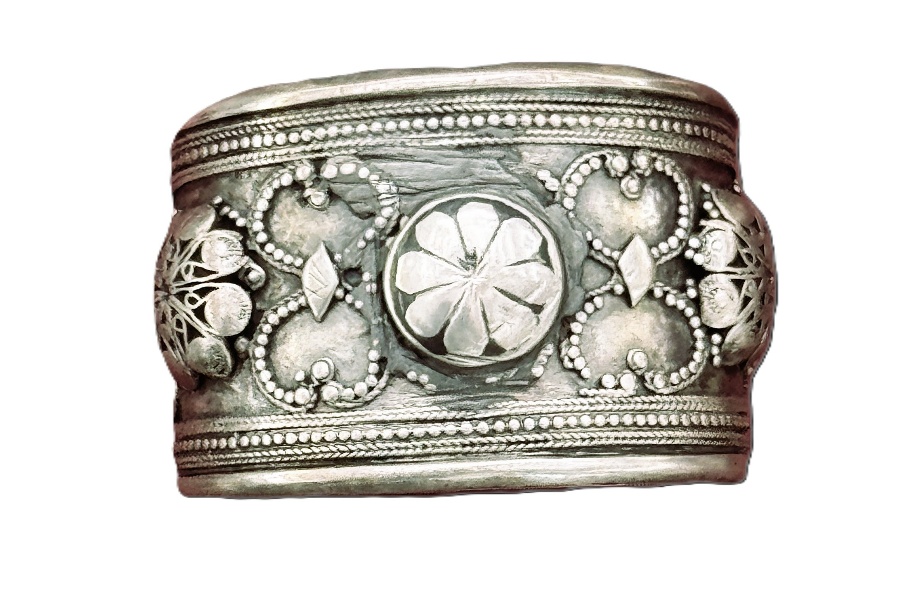
Bilezik — a cuff-style wrist ornament characteristic of the 20th-century Western Kazakh tradition of jewellery art. The piece belongs to the ceremonial category and is distinguished by its high decorative richness.The material is silver; the techniques used include stamping, chasing, granulation and blackening. The combination of openwork and relief elements against a blackened background creates a complex textured surface and enhances the contrast of the ornamentation.The design consists of a wide, plate-like base of an almost closed type. The bracelet’s form is characterised by its massiveness and the even distribution of decorative elements across the entire surface. The upper and lower edges are adorned with ornamental bands framing the central field.The composition is arranged in a frieze-like pattern with a central medallion. In the centre is a circular element with a relief rosette, serving as the compositional core. On either side of it are symmetrically arranged decorative elements, including rounded forms, diamond-shaped inserts and plant motifs. The ornamental elements are connected by chains of beads, forming a rhythmic grid.The ornamental scheme combines floral and geometric motifs. The central rosette can be interpreted as a stylised floral or solar symbol. The use of granulation creates the effect of a fragmented, shimmering surface, whilst repoussé highlights the contours of the elements. The contrast between the light metal and the darkened areas enhances the graphic quality and lends the piece an expressive decorative character.