
Kise belt
Leather, metal, stamping, gilding, silver engraving, smalt inlay. A. Kasteev National Museum of Arts of the Republic of Kazakhstan
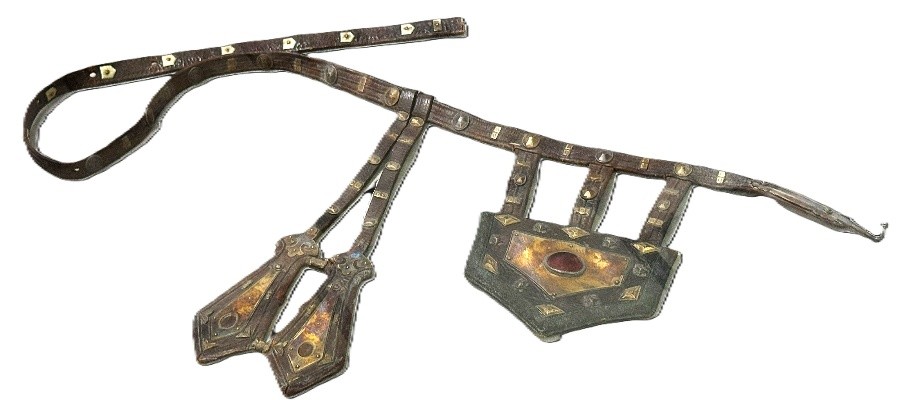
Kise Beldik (hunting belt). The item is a traditional hunting belt (kise), serving both a utilitarian and a status-decorative function. Structurally, the belt consists of a leather base with an elaborate system of hanging straps and functional elements designed to carry hunting equipment.The composition features an asymmetrically organised structure: vertical straps are attached to the main belt, ending in solid metal plates and functional details. The central element is designed as a trapezoidal plate with a smalt inlay, serving as a compositional accent. The side straps have flared ends, visually balancing the overall structure of the piece.The decorative design is based on a combination of geometric forms and minimalist ornamentation. The surfaces of the metal elements are finished with stamping, complemented by silver engraving and local gilding, creating a polychromatic effect whilst maintaining a restrained colour palette. The smalt inlay emphasises the centre of the composition and serves as a focal point.Technologically, the piece demonstrates a range of traditional metalworking techniques integrated with leather craftsmanship. The metal plates are secured to the leather base using rivets, ensuring the structure’s durability during active use.Overall, the belt reflects a functionally oriented type of ornamentation, in which decorative qualities are subordinate to practical purpose, yet retain a high degree of artistic refinement characteristic of Kazakh applied art of the late 19th century.