
Tumar, silver; blackening, casting, engraving. Source: the artist’s Instagram page — @silver_yuldabaev
Yuldabaevs (dynasty)
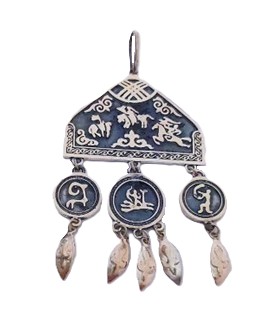
This traditional-style pectoral amulet — a tumar — is crafted in the form of a trapezoidal pendant with additional lower elements. The main body is complemented by a system of hinged modules, allowing the piece to retain its mobility and acquire an expressive rhythm when in motion.The composition is based on clear symmetry and geometric order. The upper part is designed as a trapezoidal plate with an ornament executed using the blackening technique. The contrast between the dark background and the light metallic pattern enhances the graphic expressiveness of the surface. The lower tier is formed by three circular medallions with symbolic images, complemented by teardrop-shaped pendants that create a rhythmically organised structure.The tumar retains the protective function characteristic of traditional culture. The ornamental and symbolic elements are perceived as symbols of protection and sacred patronage, whilst the movable pendants reinforce the significance of the sound characteristic of amulets. The geometric organisation of the composition emphasises the ideas of harmony and inner order that underpin the traditional worldview.The blackening technique takes on particular significance in the artistic design, making the ornament more contrasting and plastically expressive. While preserving the canonical form of the traditional tumar, the artist simultaneously brings the piece into the realm of contemporary jewellery art. As a result, the piece is perceived as a fusion of sacred function, decorative complexity and the continuity of the jewellery tradition.