Traditional and contemporary art of Kazakhstan

A Virtual Journey into the World of Kazakhstan’s Artistic Heritage

This Web Gallery presents the diversity of artistic practices in Kazakhstan, reflecting the continuity of cultural traditions and the dynamic development of contemporary creative processes. The virtual exhibition features works based on national images, symbols, and themes, as well as artworks by contemporary artists who reinterpret the country’s cultural heritage through contemporary artistic forms, expressive means, and modern technologies.

The selected works demonstrate the relationship between traditional and contemporary art, revealing the distinctive features of the national worldview, cultural identity, and cultural meanings. The presented materials allow viewers to trace how elements of historical and cultural heritage are reflected in contemporary artistic practice, while maintaining their significance and relevance in an increasingly globalized world.

The Web Gallery is aimed at promoting Kazakhstan’s artistic heritage, expanding public access to works of art, and fostering a lasting interest in national culture and art among a wide audience.

At Zhabu, 1950

Abdukarimova, 1970. • Rug. Felt, felting, mosaic • From the collection of the A. Kasteev National Museum of Arts of the Republic of Kazakhstan (235-b).
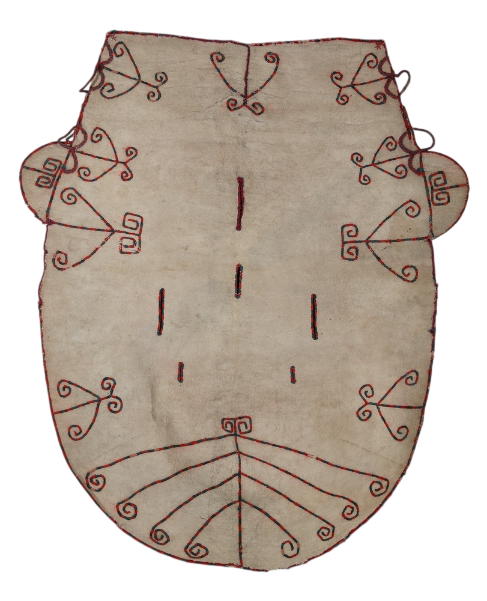
This piece is characterised by a radially centred composition, which in folk tradition is associated with the solar circle and the infinity of existence. The design is based on the mirror-like contrast between two colours—rich red and natural white (or light grey). The uniqueness of the mosaic technique lies in the simultaneous cutting of the pattern from two layers of felt superimposed on one another, which produces two pieces identical in design but opposite in colour, where the background of one becomes the pattern of the other. The central medallion is adorned with the classic four-pointed ‘muyiz’ motif, from which dynamic spiral branches radiate outwards along the outer ring, creating a sense of rotation. The rug is given particular expressiveness by the contour cord laid at the junction of the two colours: it not only conceals the seams but also graphically emphasises the fluidity and elasticity of each line. The yellow edging of the details adds brightness and visual volume to the piece.