
Bilezik
North Kazakhstan. Silver, engraving, stamping, repoussé. A. Kasteyev National Museum of Arts of the Republic of Kazakhstan
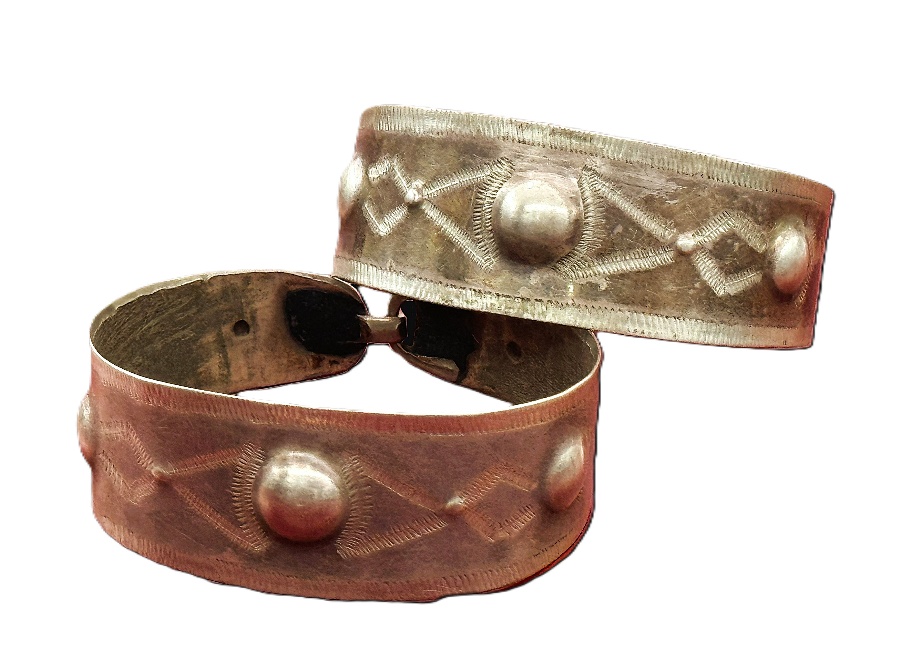
A bilezik is a cuff-style wrist ornament characteristic of the 20th-century jewellery tradition of Northern Kazakhstan. The piece belongs to the category of everyday-ceremonial jewellery and is distinguished by its restrained form and expressive relief decoration.The material is silver; the techniques used include chasing, stamping and engraving. The ornamentation is formed primarily through relief hammering and linear surface treatment.The design consists of a wide, almost closed bracelet form with a hinged clasp. The base is formed as a single metal band with a smooth inner surface and pronounced outer relief. The ends are joined by a simple clasp mechanism that secures the bracelet on the wrist.The composition is constructed on a frieze principle with a uniform distribution of decorative elements across the entire surface. The main ornamental band features an alternation of hemispherical convex elements and line-engraved geometric motifs. The central convexities serve as rhythmic accents and organise the composition.The ornamental system combines geometric and symbolic motifs. Zigzag and diamond-shaped elements form a continuous ornamental row, emphasising the length of the form. The relief hemispheres create a play of light and shadow, enhancing the piece’s plastic expressiveness. Overall, the ornament demonstrates a tendency, characteristic of northern regions, towards a concise yet structurally clear decorative solution.