
Tuyreuis
Pavlodar Region. Silver, engraving, blackening, carving. A. Kasteev National Museum of Arts of the Republic of Kazakhstan
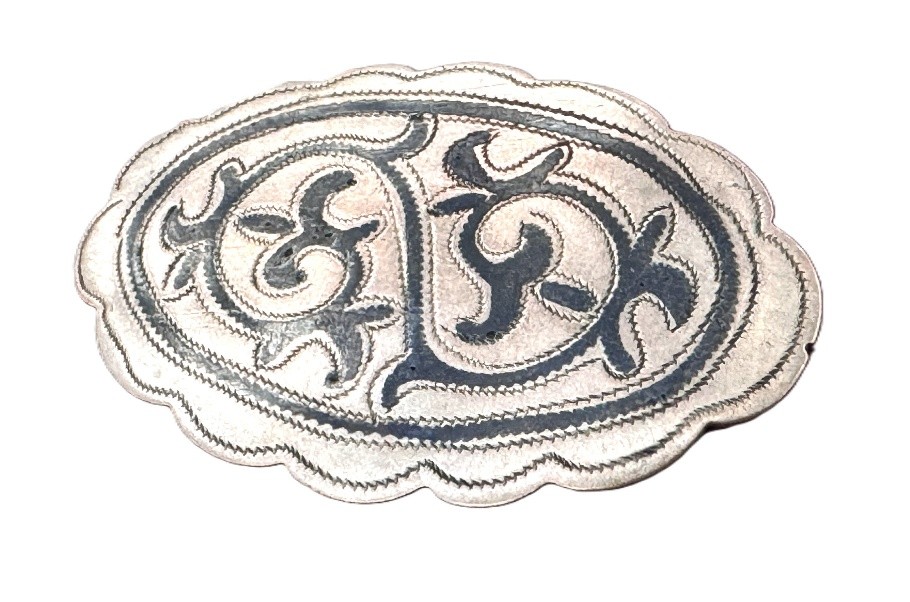
Tuireuish (brooch). The piece is a flat, decorative oval-shaped brooch with a contoured outline. It is constructed as a single metal plate with a slight relief, designed to be fastened to clothing.The composition is based on the principle of mirror symmetry and is centred on the longitudinal axis. The ornamental field is filled with a stylised plant motif, drawing on the tradition of the Kazakh ‘koshqar muiz’ ornament. The scrolls form a closed, dynamic structure organised within a double contour frame.The decorative effect is achieved through a combination of engraving and blackening: the recessed areas of the ornament are filled with a dark compound, which enhances the graphic expressiveness of the design and emphasises the rhythm of the lines. The outline of the piece is further accentuated by a notched line forming a decorative frame.Technologically, the piece was produced using the cut-out method followed by hand finishing of the surface. The ornament was cut out and refined by engraving, after which individual elements were blackened to enhance the contrast.The brooch reflects a style of concise yet expressive ornamentation characteristic of the late 19th century, in which the leading role is played by an ornamental composition based on traditional motifs and graphic precision of execution.