
Kobyz, 21st century. Wood, leather, carving, strings, mixed media.
Almas Mustafayev
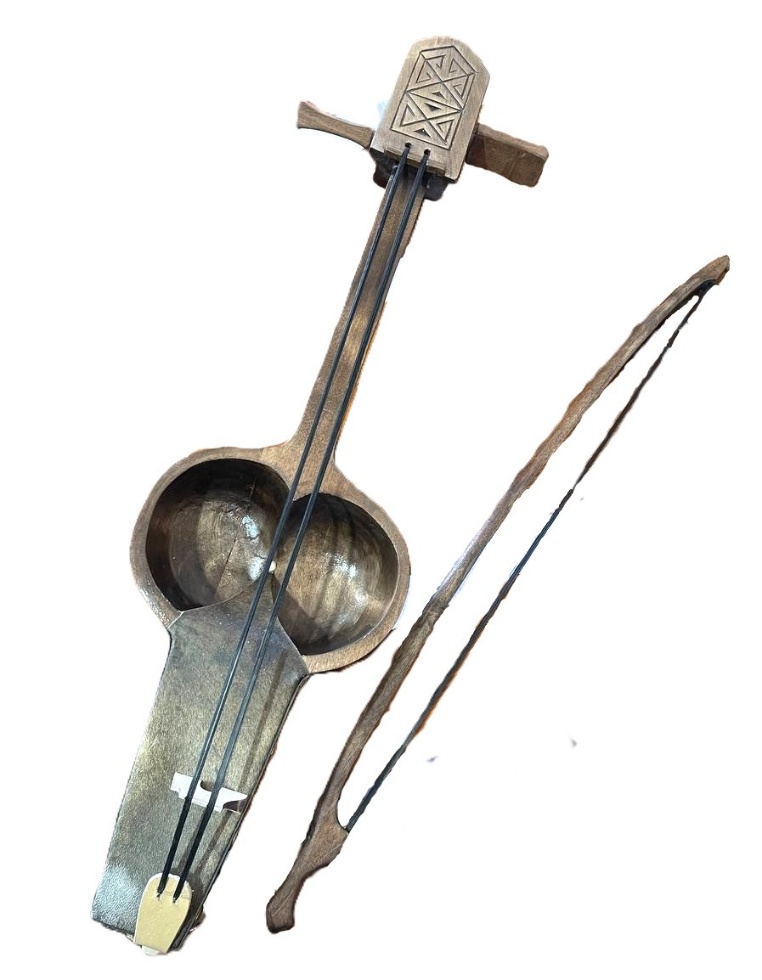
An archaic interpretation of the form defines the artistic character of this kobyz, crafted from wood whilst retaining the traditional solid-carved construction. The instrument retains the canonical features of the historical model: an elongated neck merging into a hemispherical resonator body, as well as a bowing system dating back to the ancient Turkic musical tradition.The pronounced materiality of the wood lends the piece a particular expressiveness. The surface irregularities, traces of hand-working and the preservation of the material’s natural plasticity create the impression of an object existing outside the modern industrial context. As a result, the object is perceived not as a stylised reconstruction, but as a vessel of deep cultural memory linked to the archaic forms of steppe musical culture.The carved decoration is concentrated mainly in the upper part of the neck and is executed in a concise, geometric style. The ornamentation does not dominate the structure, but merely accentuates individual compositional zones, emphasising the integrity of the silhouette and the tectonics of the form. Visual expressiveness is achieved primarily through the plasticity of the material itself, rather than through the decorative richness of the surface.The bow retains the natural curvature of the wood and is conceived as an organic extension of the instrument. This approach strengthens the object’s connection with the natural environment and highlights the artisanal, individualised nature of its craftsmanship. As a result, the kobyz acquires the qualities not only of a musical instrument but also of a sculptural art object.The work reflects the desire, characteristic of contemporary Kazakhstani decorative and applied art, to reinterpret traditional forms by emphasising the archetypal nature of the image, the texture of the material and cultural continuity.