
Mausoleum painting
Photograph and drawing by A. Ordabaev
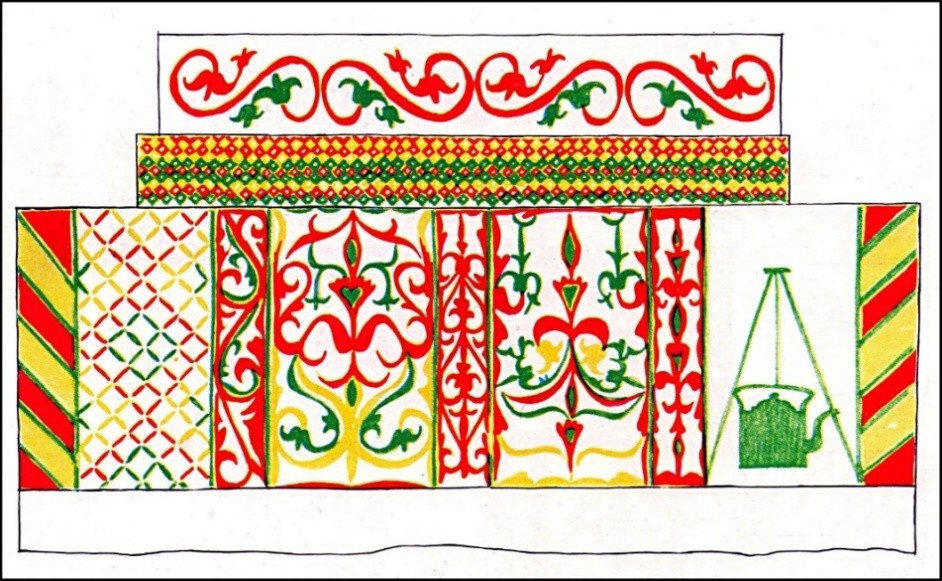
Analysing the paintings, A.H. Margulan had already compared their composition with yurt decoration, pointing to the presence of narrative scenes: caravans of camels, hunting scenes, summer encampments with tethered foals, horsemen in military attire, as well as depictions of household items, clothing and jewellery. Each composition ‘reads’ as a symbolic metaphor: the caravan is interpreted as the flow of life, the jailau as an image of a pastoral paradise, and the horsemen as the embodiment of valour and honour.A virtually complete imitation of a yurt’s interior can be seen in the Zhantay Mausoleum (Merke District, Zhambyl Region), whose vault is covered in frescoes. The central motif is a large caravan moving from right to left. The composition is characterised by rich polychromy: the outermost camels and three horses are painted blue, the remaining camels yellow, the wild goats green, and the saddlecloths red. It is likely that the colour differentiation has symbolic significance, and the direction of the caravan’s movement is interpreted as a journey into the ‘other world’: the left side is associated with the realm of the dead, whilst the right is associated with the realm of the living, the south and the east.