
Adalbakan
Adalbakans. • From the private collection • of S.M. Bashirov. Photograph by Zh. Karimova
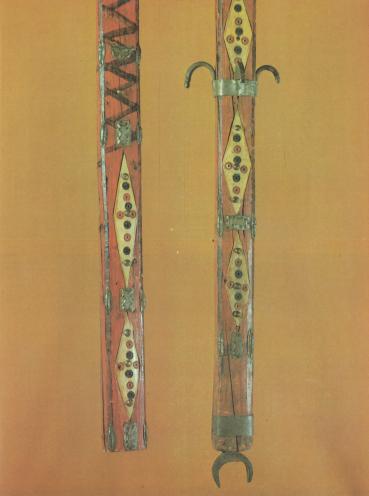
Adalbakhan is a traditional wooden pole with a fork at the top and hooks for hanging clothes, horse equipment, weapons, etc. Adalbakhans were installed in the right, male part of the yurt, between the beds and the place of honour of the tor. The system of hooks placed around the adalbakana resembles the arrangement of tree branches, which allows researchers to compare the symbolic image of the adalbakana with the semantic meaning of the mythopoetic image of the World Tree (Tokhtabaeva 26). The significance of the adalbakhan in the yurt is reflected in folk beliefs – the pole-hanger personified the idea of order; there were strict prohibitions on its use – it was forbidden to step over it or drop it, so as not to scare away the family’s well-being. The shapes of adalbakans were not strictly canonical – sometimes they were turned on a lathe, allowing for alternating volumes of cylinders, cones, rollers, etc.; flat shapes of hangers and combinations of carved and flat shapes are also known. There were also composite adalbakans. As in other cases of decorating wooden items in a yurt, adalbakans were decorated with inlaid bone plates with curved edges, fastened with silver nails with round heads, silver flat and hemispherical plates decorated with engraving with blackening and embossing. In the adalbakana, its flat shape is reinforced with metal fittings, and at the top there is a fork that supported the dome pole – uyk. The decoration consists of alternating metal relief plates and bone rhombic figures with painted circular circles and hemispherical nail heads. The wooden adalbakans from S.M. Bashirov’s collection are interesting: on one of them, the engraved ornament is complemented by metal figured plates; on the second, there is a fork for a uyka at the top of the hanger, below which there is a vortex rosette made using the three-sided notch carving technique, and below it there are rhythmically engraved plant elements, painted in various colours in the depths of the engraving.