
Bilezik
North Kazakhstan. Silver, malachite, turquoise, granulation, filigree. A. Kasteyev National Museum of Arts of the Republic of Kazakhstan
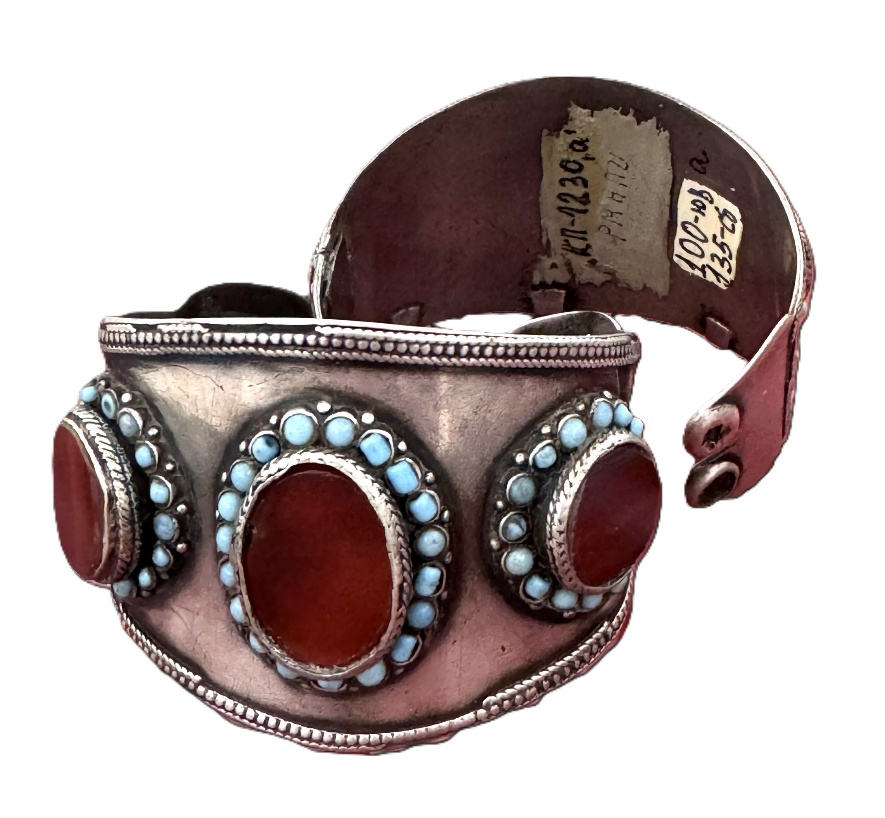
Bilezik — a cuff-style wrist ornament characteristic of the 20th-century jewellery tradition of Northern Kazakhstan. The piece is a ceremonial item and is distinguished by its rich decorative quality, achieved through the use of gemstone inlays.Material: silver; decorative elements include coloured stone inlays (presumably carnelian and turquoise). The technique combines filigree and granulation, forming openwork and relief frames around the inlays.The design consists of a wide, almost closed bracelet form with open ends. The main volume is concentrated in the central section, where large, applied elements with gemstone inlays are set. The inner surface remains smooth, whilst the outer surface is richly decorated.The composition is constructed on a frieze principle with a rhythmic alternation of large oval inlays. The central stones are framed by a double band: an inner band of a metal cast ring, and an outer band of small turquoise inlays forming an ornamental frame. This technique creates clearly defined compositional accents and establishes a visual rhythm.The ornamental scheme is based on a combination of colour and textural contrasts. Large red inlays serve as the dominant elements, whilst small turquoise elements create a decorative setting and enhance the richness of the composition. The use of scallops and granulation emphasises the contours and lends the surface a shimmering effect. Overall, the piece demonstrates a combination of ornamentation, colour symbolism and expressive plasticity of form characteristic of traditional jewellery art.