Traditional and contemporary art of Kazakhstan

A Virtual Journey into the World of Kazakhstan’s Artistic Heritage

This Web Gallery presents the diversity of artistic practices in Kazakhstan, reflecting the continuity of cultural traditions and the dynamic development of contemporary creative processes. The virtual exhibition features works based on national images, symbols, and themes, as well as artworks by contemporary artists who reinterpret the country’s cultural heritage through contemporary artistic forms, expressive means, and modern technologies.

The selected works demonstrate the relationship between traditional and contemporary art, revealing the distinctive features of the national worldview, cultural identity, and cultural meanings. The presented materials allow viewers to trace how elements of historical and cultural heritage are reflected in contemporary artistic practice, while maintaining their significance and relevance in an increasingly globalized world.

The Web Gallery is aimed at promoting Kazakhstan’s artistic heritage, expanding public access to works of art, and fostering a lasting interest in national culture and art among a wide audience.

Tumar-2. From the ‘Tumar’ series, 2016. Wool, felting

Aizhan Bekkulova
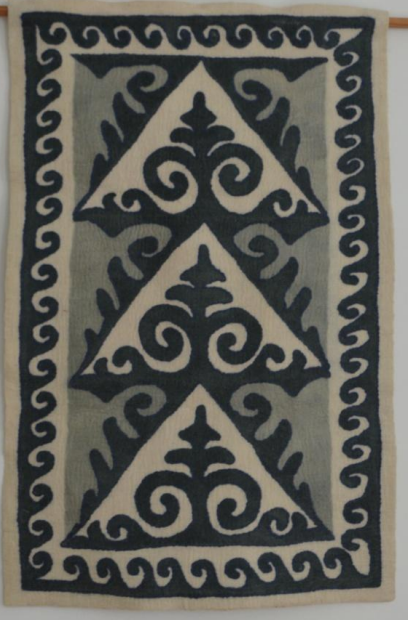
The work ‘Tumar-2’ from the ‘Tumar’ series is a contemporary interpretation of a traditional Kazakh amulet, in which an ancient sacred symbol is reimagined through the medium of textile art. The composition is based on three vertically arranged triangles — a shape directly linked to the archetype of the tumar as a protective amulet. Their repetition creates a rhythm of ascent and reinforces the idea of multi-layered sacred protection.The central ‘muyiz’ ornament within each element takes on the symbolic meaning of life force, continuity and spiritual energy. The pattern’s upward direction reinforces associations with the tree of life and the idea of inner growth. The undulating irek ornament around the perimeter serves a semiotic function as a boundary, forming a self-contained space of protection.The monochrome palette of graphite, grey and white evokes the aesthetics of traditional felted items and emphasises the simplicity of the form. The absence of bright, decorative elements draws attention to the symbolic content and rhythm of the ornament.